


Page 397 - Bài 1
P. 397
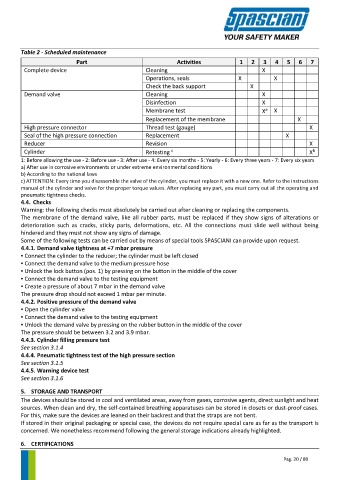
Table 2 - Scheduled maintenance

                            Part                               Activities            1   2    3   4   5   6   7
          Complete device                           Cleaning                                 X
                                                    Operations, seals                X           X
                                                    Check the back support               X
          Demand valve                              Cleaning                                 X
                                                    Disinfection                             X
                                                                                              a
                                                    Membrane test                            X   X
                                                    Replacement of the membrane                           X
          High pressure connector                   Thread test (gauge)                                       X
          Seal of the high pressure connection      Replacement                                      X
          Reducer                                   Revision                                                  X
          Cylinder                                  Retesting                                                 X
                                                             c
                                                                                                               b
        1: Before allowing the use - 2: Before use - 3: After use - 4: Every six months - 5: Yearly - 6: Every three years - 7: Every six years
        a) After use in corrosive environments or under extreme environmental conditions
        b) According to the national laws
        c) ATTENTION: Every time you disassemble the valve of the cylinder, you must replace it with a new one. Refer to the instructions
        manual of the cylinder and valve for the proper torque values. After replacing any part, you must carry out all the operating and
        pneumatic tightness checks.
        4.4. Checks
        Warning: the following checks must absolutely be carried out after cleaning or replacing the components.
        The membrane of the demand valve, like all rubber parts, must be replaced if they show signs of alterations or
        deterioration such as cracks, sticky parts, deformations, etc. All the connections must slide  well  without being
        hindered and they must not show any signs of damage.
        Some of the following tests can be carried out by means of special tools SPASCIANI can provide upon request.
        4.4.1. Demand valve tightness at +7 mbar pressure
        • Connect the cylinder to the reducer; the cylinder must be left closed
        • Connect the demand valve to the medium pressure hose
        • Unlock the lock button (pos. 1) by pressing on the button in the middle of the cover
        • Connect the demand valve to the testing equipment
        • Create a pressure of about 7 mbar in the demand valve
        The pressure drop should not exceed 1 mbar per minute.
        4.4.2. Positive pressure of the demand valve
        • Open the cylinder valve
        • Connect the demand valve to the testing equipment
        • Unlock the demand valve by pressing on the rubber button in the middle of the cover
        The pressure should be between 3.2 and 3.9 mbar.
        4.4.3. Cylinder filling pressure test
        See section 3.1.4
        4.4.4. Pneumatic tightness test of the high pressure section
        See section 3.1.5
        4.4.5. Warning device test
        See section 3.1.6

        5.  STORAGE AND TRANSPORT
        The devices should be stored in cool and ventilated areas, away from gases, corrosive agents, direct sunlight and heat
        sources. When clean and dry, the self-contained breathing apparatuses can be stored in closets or dust-proof cases.
        For this, make sure the devices are leaned on their backrest and that the straps are not bent.
        If stored in their original packaging or special case, the devices do not require special care as far as the transport is
        concerned. We nonetheless recommend following the general storage indications already highlighted.

        6.  CERTIFICATIONS

                                                                                                                        Pag. 20 / 80

