


Page 75 - EW August 2025
P. 75
tion-focused think-tank (estb. 1997).                             public education the centrepiece of its
         “The major drawback of AAP’s educa-                               electoral and governance agenda. AAP
         tion reforms was failure to institution-                          shifted education from the political
         alise practices, processes, rules and                             and budgetary sidelines to the front
         norms. These are the most difficult                               pages of manifestos and mainstream
         part of any reform. Time, persistence                             public debate. That, in itself, was no
         and patience is required to implement                             small accomplishment.
         them sustainably. To its credit, the                                Yet the fate of Delhi’s government
         Delhi government under AAP consis-                                schools after ten years serves as a so-
         tently allocated more than 25 percent                             bering reminder that vision alone is
         of the state budget to education dur-                             not enough. Despite the increase in
         ing the years they were in power. No                              the number of classrooms, headline
         other Indian state government had so                              reforms like the Happiness Curricu-
         decisively made school reform its sig-                            lum and Mission Buniyaad, and a me-
         nature political project or invested so                           dia blitz devoted to teacher training
         heavily in public messaging about its   Raman: public relations success  and infrastructure, the core learning
         achievements. But from 2015 onward,                               crisis endured. Student engagement
         AAP leaders launched program after   a  pivotal  role  in efforts  to  improve   and outcomes did not rise to match
         program, too quickly in succession for   education. But they were subjected   the scale of the investment, and deep
         them to be effective,” says Shah.   to a constant stream of urgent new   structural bottlenecks continued to
           These initiatives included large-  orders and official notices. These in-  hold the system back. Reforms, how-
         scale investments in school infrastruc-  structions typically provided little   ever ambitious, often became just an-
         ture, introduction of new pedagogical   opportunity for implementation and   other burden for already overworked
         models such as Teaching at the Right   rarely engaged with the everyday re-  teachers and administrators, arriving
         Level (TaRL), and initiatives like Chu-  alities of classroom teaching. Policies   so quickly and frequently that they
         nauti and Mission Buniyaad designed   were dictated from higher authorities,   undermined genuine change instead
         to address foundational learning gaps.   outlining what must be done but the   of reinforcing it.
         High-profile curricular changes, such   vital support that teachers needed to   Ultimately, AAP fell into the age-
         as the Happiness Curriculum, and   implement the mandated changes was   old trap of Indian education reform:
         high-octane parental engagement   seldom provided.                believing that new programs, addi-
         drives and mega-PTMs, followed in   “The AAP education reforms were   tional funds, or innovative slogans are
         quick succession.                able to touch ground, at least in some   sufficient to drive real transformation.
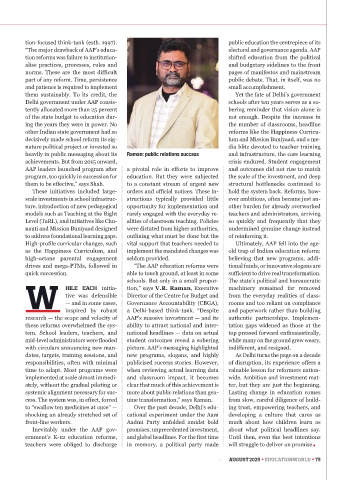
         W            HILE EACH  initia-  tion,” says V.R. Raman, Executive   machinery remained far removed
                                          schools. But only in a small propor-
                                                                           The state’s political and bureaucratic
                                          Director of the Centre for Budget and
                      tive was defensible
                                                                           from the everyday realities of class-
                      — and in some cases,
                                                                           and paperwork rather than building
                      inspired by robust   Governance Accountability (CBGA),   rooms and too reliant on compliance
                                          a Delhi-based think-tank. “Despite
         research — the scope and velocity of   AAP’s massive investment — and its   authentic partnerships. Implemen-
         these reforms overwhelmed the sys-  ability to attract national and inter-  tation gaps widened as those at the
         tem.  School  leaders,  teachers,  and   national headlines — data on actual   top pressed forward enthusiastically,
         mid-level administrators were flooded   student outcomes reveal a sobering   while many on the ground grew weary,
         with circulars announcing new man-  picture. AAP’s messaging highlighted   indifferent, and resigned.
         dates, targets, training sessions, and   new  programs, slogans, and highly   As Delhi turns the page on a decade
         responsibilities, often with minimal   publicised success stories. However,   of disruption, its experience offers a
         time to adapt. Most programs were   when reviewing actual learning data   valuable lesson for reformers nation-
         implemented at scale almost immedi-  and classroom impact, it becomes   wide. Ambition and investment mat-
         ately, without the gradual piloting or   clear that much of this achievement is   ter, but they are just the beginning.
         systemic alignment necessary for suc-  more about public relations than gen-  Lasting change in education comes
         cess. The system was, in effect, forced   uine transformation,” says Raman.  from slow, careful diligence of build-
         to “swallow ten medicines at once” —   Over the past decade, Delhi’s edu-  ing trust, empowering teachers, and
         shocking an already stretched set of   cational experiment under the Aam   developing a culture that cares as
         front-line workers.              Aadmi Party unfolded amidst bold   much about how children learn as
           Inevitably under the AAP gov-  promises, unprecedented investment,   about what political headlines say.
                                                                           Until then, even the best intentions
         ernment’s K-12 education reforms,   and global headlines. For the first time   will struggle to deliver on promise.
         teachers were obliged to discharge   in memory, a political party made

                                                                           AUGUST 2025    EDUCATIONWORLD   75

