


Page 20 - EW-January-2026
P. 20
Education News


           DELHI                                                           our faculty has registered over 4,000
         Chitkara University's research breakthrough                       patents. A good example of our com-

                                                                           mitment to R&D is exemplified by a
                                                                           project to reduce the pollution fallout
                                                                           of annual stubble burning by Punjab
                                                                           farmers. I am pleased to inform you
                                                                           that our researchers have developed
                                                                           sustainable technologies to convert
                                                                           agricultural stubble into marketable
                                                                           products  which  will  significantly
                                                                           reduce environmental pollution in
                                                                           Delhi and Punjab,” she informed the
                                                                           audience comprising Vice Chancel-
                                                                           lors and Deans of India’s top-ranked
                                                                           private and public universities at the
                                                                           EWIHERA conclave.
                                                                             True to her word 18 months later, a
                                                                           team of researchers from CURIN have
                                                                           developed an eco-friendly technology
                                                                           that converts rice straw residue into
                                                                           high-purity silica gel using a sustain-
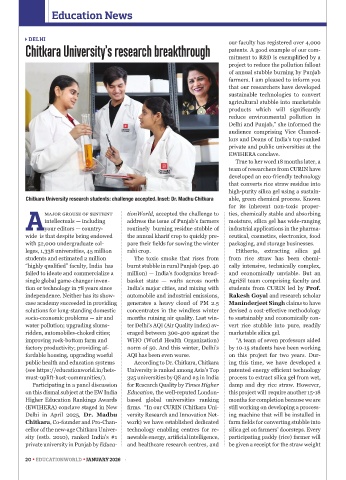
         Chitkara University research students: challenge accepted. Inset: Dr. Madhu Chitkara  able, green chemical process. Known
                                                                           for its inherent non-toxic proper-
               major grouse of sentient   tionWorld, accepted the challenge to   ties, chemically stable and absorbing
               intellectuals — including   address the issue of Punjab’s farmers   moisture, silica gel has wide-ranging
         A your editors — country-        routinely  burning residue stubble of   industrial applications in the pharma-
         wide  is that despite being endowed   the annual kharif crop to quickly pre-  ceutical, cosmetics, electronics, food
         with 52,000 undergraduate col-   pare their fields for sowing the winter   packaging, and storage businesses.
         leges, 1,338 universities, 45 million   rabi crop.                  Hitherto,  extracting  silica  gel
         students and estimated 2 million   The toxic smoke that rises from   from rice straw has been chemi-
         “highly qualified” faculty, India  has   burnt stubble in rural Punjab (pop. 40   cally intensive, technically complex,
         failed to ideate and commercialize a   million) — India’s foodgrains bread-  and economically unviable. But an
         single global game-changer inven-  basket state — wafts across north   AgriSil team comprising faculty and
         tion or technology in 78 years since   India’s major cities, and mixing with   students from CURIN  led by  Prof.
         independence. Neither has its show-  automobile and industrial emissions,     Rakesh Goyal and research scholar
         case academy succeeded in providing   generates a heavy cloud of PM 2.5   Maninderjeet Singh claims to have
         solutions for long-standing domestic   concentrates in the windless winter   devised a cost-effective methodology
         socio-economic problems — air and   months ruining air quality. Last win-  to sustainably and economically con-
         water pollution; upgrading slums-  ter Delhi’s AQI (Air Quality Index) av-  vert rice stubble into pure, readily
         ridden, automobiles-choked cities;   eraged between 300-400 against the   marketable silica gel.
         improving rock-bottom farm and   WHO (World Health Organization)    “A team of seven professors aided
         factory productivity; providing af-  norm of 50. And this winter, Delhi’s   by 10-15 students have been working
         fordable housing, upgrading woeful   AQI has been even worse.     on this project for two years. Dur-
         public health and education systems   According to Dr. Chitkara, Chitkara   ing this time, we have developed a
         (see https://educationworld.in/heis-  University is ranked among Asia’s Top   patented energy efficient technology
         must-uplift-host-communities/).   325 universities by QS and #3 in India   process to extract silica gel from wet,
            Participating in a panel discussion   for Research Quality by Times Higher   damp and dry rice straw. However,
         on this dismal subject at the EW India   Education, the well-reputed London-  this project will  require another 15-18
         Higher Education Rankings Awards   based global universities ranking   months for completion because we are
         (EWIHERA) conclave staged in New   firms.  “In our CURIN (Chitkara Uni-  still working on developing a process-
         Delhi in April  2025,  Dr. Madhu   versity Research and Innovation Net-  ing machine that will be installed in
         Chitkara, Co-founder and Pro-Chan-  work) we have established dedicated   farm fields for converting stubble into
         cellor of the new-age Chitkara Univer-  technology enabling centres for re-  silica gel on farmers’ doorsteps. Every
         sity (estb. 2010), ranked India’s #1   newable energy, artificial intelligence,   participating paddy (rice) farmer will
         private university in Punjab by Educa-  and healthcare research centres, and   be given a receipt for the straw weight

         20    EDUCATIONWORLD   JANUARY 2026

