


Page 57 - EW-January-2026
P. 57
(Hub) ones for mentorship, fostering                                          dated 22.5 percent).
         collaboration, and transforming In-                                             The character of
         dia's research landscape into a vibrant                                       this showpiece na-
         ecosystem for innovation and global                                           tional university es-
         leadership.                                                                   tablished as an essen-
         T        THE OUTCOME OF students                                              institution has also
                                                                                       tially deep research
                                                                                       changed  under  the
                  and faculty being ranged
                  against the JNU admin-
                  istration/management is                                              new  political dispen-
                                                                                       sation,  inasmuch  as
         that this institution which shaped a                                          research students are
         large number of India’s best schol-                                           now outnumbered by
         ars, is in danger of losing its liberal                                       students in undergrad
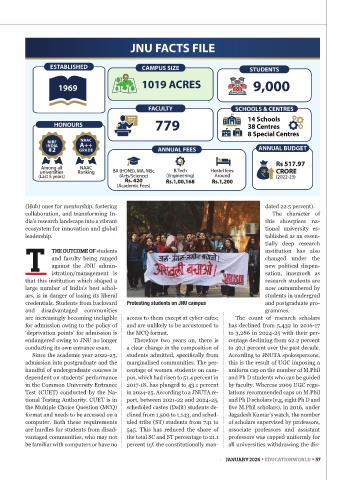
         credentials. Students from backward   Protesting students on JNU campus       and postgraduate pro-
         and  disadvantaged  communities                                               grammes.
         are increasingly becoming ineligible   access to them except at cyber cafes;   The count of research scholars
         for admission owing to the policy of   and are unlikely to be accustomed to   has declined from 5,432 in 2016-17
         ‘deprivation points’ for admission is   the MCQ format.           to 3,286 in 2024-25 with their per-
         endangered owing to JNU no longer   Therefore two years on, there is   centage declining from 62.2 percent
         conducting its own entrance exam.   a clear change in the composition of   to 40.1 percent over the past decade.
           Since the academic year 2022-23,   students admitted, specifically from   According to JNUTA spokespersons,
         admission into postgraduate and the   marginalised communities. The per-  this is the result of UGC imposing a
         handful of undergraduate courses is   centage of women students on cam-  uniform cap on the number of M.Phil
         dependent on students’ performance   pus, which had risen to 51.4 percent in   and Ph D students who can be guided
         in the Common University Entrance   2017-18, has plunged to 43.1 percent   by faculty. Whereas 2009 UGC regu-
         Test (CUET) conducted by the Na-  in 2024-25. According to a JNUTA re-  lations recommended caps on M.Phil
         tional Testing Authority. CUET is in   port, between 2021-22 and 2024-25,   and Ph D scholars (e.g, eight Ph D and
         the Multiple Choice Question (MCQ)   scheduled castes (Dalit) students de-  five M.Phil scholars), in 2016, under
         format and needs to be accessed on a   clined from 1,500 to 1,143, and sched-  Jagadesh Kumar’s watch, the number
         computer.  Both  these  requirements   uled tribe (ST) students from 741 to   of scholars supervised by professors,
         are hurdles for students from disad-  545.  This has  reduced the share  of   associate professors and assistant
         vantaged communities, who may not   the total SC and ST percentage to 21.1   professors was capped uniformly for
         be familiar with computers or have no   percent (cf. the constitutionally man-  all universities withdrawing the dis-

                                                                          JANUARY 2026    EDUCATIONWORLD   57

