


Page 79 - EW-January-2026
P. 79
searchers of Chinese descent to leave the US for China.

           CHINA
         Towards global scientific leadership

                “THE  US  IS  FALLING  APART…  THIS  PRESI-
                DENT and his crew are destroying all of what made
                America great.” This lament at a recent Hong Kong
         Laureate Forum from Nobel prizewinning German astro-
         physicist Reinhard Genzel — who for many years had a
         part-time full professorship at the University of California,
         Berkeley — is far from an isolated cri de coeur.
           On the crowded conference floor, Trump-induced fund-
         ing chaos, visa restrictions and tightened security protocols
         around overseas collaboration were widely discussed by the
         hundreds of attending early-career researchers and handful
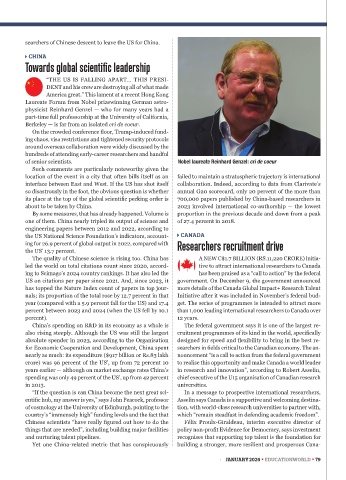
         of senior scientists.                            Nobel laureate Reinhard Genzel: cri de coeur
           Such comments are particularly noteworthy given the
         location of the event in a city that often bills itself as an   failed to maintain a stratospheric trajectory is international
         interface between East and West. If the US has shot itself   collaboration. Indeed, according to data from Clarivate’s
         so disastrously in the foot, the obvious question is whether   annual G20 scorecard, only 20 percent of the more than
         its place at the top of the global scientific pecking order is   700,000 papers published by China-based researchers in
         about to be taken by China.                      2023 involved international co-authorship — the lowest
           By some measures, that has already happened. Volume is   proportion in the previous decade and down from a peak
         one of them. China nearly tripled its output of science and   of 27.4 percent in 2018.
         engineering papers between 2012 and 2022, according to
         the US National Science Foundation’s indicators, account-   CANADA
         ing for 26.9 percent of global output in 2022, compared with   Researchers recruitment drive
         the US’ 13.7 percent.
           The quality of Chinese science is rising too. China has   A NEW C$1.7 BILLION (RS.11,220 CRORE) initia-
         led the world on total citations count since 2020, accord-  tive to attract international researchers to Canada
         ing to Scimago’s 2024 country rankings. It has also led the   has been praised as a “call to action” by the federal
         US on citations per paper since 2021. And, since 2023, it   government. On December 9, the government announced
         has topped the Nature Index count of papers in top jour-  more details of the Canada Global Impact+ Research Talent
         nals; its proportion of the total rose by 12.7 percent in that   Initiative after it was included in November’s federal bud-
         year (compared with a 5.9 percent fall for the US) and 17.4   get. The series of programmes is intended to attract more
         percent between 2023 and 2024 (when the US fell by 10.1   than 1,000 leading international researchers to Canada over
         percent).                                        12 years.
           China’s spending on R&D in its economy as a whole is   The federal government says it is one of the largest re-
         also rising steeply. Although the US was still the largest   cruitment programmes of its kind in the world, specifically
         absolute spender in 2023, according to the Organisation   designed for speed and flexibility to bring in the best re-
         for Economic Cooperation and Development, China spent   searchers in fields critical to the Canadian economy. The an-
         nearly as much: its expenditure ($917 billion or Rs.83 lakh   nouncement “is a call to action from the federal government
         crore) was 96 percent of the US’, up from 72 percent 10   to realise this opportunity and make Canada a world leader
         years earlier — although on market exchange rates China’s   in research and innovation”, according to Robert Asselin,
         spending was only 49 percent of the US’, up from 42 percent   chief executive of the U15 organisation of Canadian research
         in 2013.                                         universities.
           “If the question is can China become the next great sci-  In a message to prospective international researchers,
         entific hub, my answer is yes,” says John Peacock, professor   Asselin says Canada is a supportive and welcoming destina-
         of cosmology at the University of Edinburgh, pointing to the   tion, with world-class research universities to partner with,
         country’s “immensely high” funding levels and the fact that   which “remain steadfast in defending academic freedom”.
         Chinese scientists “have really figured out how to do the   Félix Proulx-Giraldeau, interim executive director of
         things that are needed”, including building major facilities   policy non-profit Evidence for Democracy, says investment
         and nurturing talent pipelines.                  recognises that supporting top talent is the foundation for
           Yet one China-related metric that has conspicuously   building a stronger, more resilient and prosperous Cana-

                                                                          JANUARY 2026    EDUCATIONWORLD   79

