


Page 46 - International Architecture & Design Sotheby's Summer 2016
P. 46
architecture
CONCRETE THE MODERN WAY
Richard Found is one of a growing class of architects using concrete not as
a means to an end but as an end in itself. Yet in his Cotswolds property, he has avoided the harsh grey tone found in art galleries and avant-garde retailers. With a local aggregate company, the architect designed a bespoke honey-coloured mix that almost perfectly matches the Cotswold stone of the attached heritage house.
Three-foot blocks of concrete tile make up the floors, ceiling and most walls in the new annex, creating a softer, warmer environment than most quintessen- tially concrete spaces. And visually, the custom concrete is less jarring than other materials. When you cast your eye through the space and out the windows, the concrete blends harmoniously with the traditional materials outside.
“I’m so pleased by how warm the concrete is and how it complements the Cotswold stone,” says Found.
Mixed from limestone, a plentiful material particularly in the Cotswolds, concrete is highly sustainable. Moreover, it is energy-efficient. Poured in place, it produces almost no construction waste, and it absorbs and retains heat, making the habitat less reliant on heating and cooling systems. Still, the warmth here comes as much from the sandy tone of the concrete—enhanced by recessed tube lighting—as its insulating properties. A vaguely mottled quality gives it personality and an earthy texture underfoot.
To hear him speak of it, you’d almost think Found was prouder of his flawless concrete walls than of the tracts of five-millimetre-thick windows facing the woodland. Long concrete hallways run the length of the property in each direction, but rather than break up the surfaces with art—of which there is no dearth in this household—Found has left them bare. “I’m reluctant to drill any holes in it,” he says.
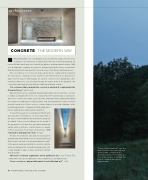
His wife, the art dealer Jane Suitor, has brought in experimental art by friends such as Jeremy Deller and Glenn Ligon, but only to a few painted-plaster walls. In the spaces enveloped entirely in concrete—like the anteroom between the old and new wings (top)—the couple struggle to agree on a piece that won’t detract from the purity.
“We have continual arguments about putting in art,” says Found. The compromise, he says, would have to be a sculpture you can walk around.
“I love concrete, so why would I want to lose it all behind art?” —E.H.
46	INTERNATIONAL ARCHITECTURE & DESIGN
The low-slung, elongated-T structure means you can only “read” one end of the modern construction at a given time, unless you’re looking at the scheme head-on. In contrast, the historic cottage at the centre is always in view.


