


Page 5 - TRPS Newsletter Volume 6 Issue 19
P. 5
Editor’s Note

 Dear Parents


 A

           s we approach the close of Term 2, this edition   beyond the school, NFER Progress Checks are more  ASSESSMENT
 of  the  newsletter  places  a  deliberate  spotlight  on  immediate  and  curriculum-aligned.  They  are  About NFER:
 Assessment  Week,  underpinned  by  our  structured  particularly  sensitive  to  incremental  progress,
 NFER Progress Checks conducted across Years 1 to 6.  capturing small but significant gains in learning that  The  NFER  paper  tests  form  a  central  pillar  of  this  PROGRESS
 These  assessments,  administered  over  a  carefully  may  otherwise  go  unnoticed.  Together,  both  process.  Developed  through  over  75  years  of
 coordinated  timetable,  are  designed  to  evaluate  assessment  systems  form  a  robust  framework—  assessment  research  and  standardised  on  tens  of
 how well pupils are performing against UK national  balancing  internal  responsiveness  with  external  thousands of pupils, they provide robust, curriculum-  AND GROWTH
 expectations,  while  also  referencing  baseline  data  validation.  aligned measures of attainment and progress. Their
 from assessments such as CAT4, NGRT, and INCAS.  design mirrors the structure and demand of national
 Across  the  school,  pupils  approached  this  process  We  would  like  to  encourage  parents  to  ensure  that  curriculum  tests,  helping  pupils  build  familiarity  and
 with  focus  and  maturity,  recognising  that  the  children  are  present  during  assessment  periods,  as  confidence   while   giving   the   school   reliable
 purpose  of  assessment  is  not  simply  to  test  consistency supports the accuracy of our evaluations.  benchmarking data. Importantly, the accompanying
 knowledge, but to demonstrate understanding and  However,  it  is  equally  important  to  stress  that  these  analysis  tools  allow  us  to  convert  raw  scores  into  Assessment is
 application.  assessments are not competitive, nor are they high-  standardised metrics and generate detailed reports,
 stakes in nature. They do not define a child’s ability or  ensuring that our decisions are evidence-based and  not the finish line,
 The  structure  of  the  Progress  Checks  reflects  both  future success. Where a child is absent or unable to  pedagogically sound.
 rigour and developmental appropriateness. In Years  complete  a  Progress  Check,  this  is  not  a  cause  for
 1 and 2, pupils engaged with NFER Mathematics and  concern. Teachers are able to draw on a wide range  but a milestone
 Reading  assessments,  while  pupils  in  Years  3  to  6  of alternative evidence, including classwork, ongoing  About OWCS:
 completed  a  broader  suite  including  Reading,  formative  assessments,  guided  reading  records,  on the journey of
 Arithmetic,  Reasoning,  Grammar  and  Punctuation,  writing  portfolios,  and  standardised  tools  such  as  Equally  important  is  the  use  of  the  Oxford  Writing
 and  Spelling.  These  were  conducted  as  formal  CAT4  and  NGRT,  to  build  a  complete  and  reliable  Criterion Scale (OWCS), designed and developed by  learning—guiding
 paper-based  assessments  within  the  classroom,  picture of each pupil.  the  renowned  English  Language  expert  Ros  Wilson,
 with  clear  protocols  for  administration,  timing,  and  which  strengthens  our  assessment  of  writing  by
 support.  Importantly,  allowances  were  made  for  Assessment at The Regent Primary School is therefore  providing  a  clear,  progressive  framework  for  every child
 pupils  with  additional  needs,  ensuring  equitable  best  understood  as  a  continuous  and  triangulated  evaluating  pupils’  composition  skills.  The  OWCS
 access and a fair testing environment for all.  process.  Beyond  formal  testing,  daily  teaching,  enables  teachers  to  assess  writing  with  greater  towards greater
 questioning,  feedback,  and  low-stakes  classroom  consistency and depth — focusing on elements such
 A key strength of this assessment model lies in the  assessments  all  contribute  to  our  understanding  of  as  composition,  organisation,  vocabulary,  and
 precision  and  reliability  of  the  data  it  generates.  each learner. The Progress Checks simply provide a  technical accuracy — while also supporting pupils in  confidence and
 Through detailed marking schemes and the use of  structured  checkpoint  within  this  broader  system—  understanding what high-quality writing looks like at
 Standardised Age Scores (SAS), teachers are able to  allowing  us  to  validate,  refine,  and  strengthen  our  each  stage  of  development.  Used  alongside  NFER  success.
 interpret  performance  in  relation  to  each  child’s  teaching  approaches  in  a  timely  and  strategic  data, it ensures that our assessment of literacy is not
 exact  age  at  the  time  of  testing.  This  level  of  manner.  only  quantitative,  but  also  qualitative,  capturing  the
 standardisation  provides  a  highly  accurate  and  full richness of each child’s writing journey.
 sensitive measure of attainment and progress. The  Ultimately, what stands out most from this week is not
 completion  of  the  Progress  Check  Cohort  Tracker  just the data collected, but the attitudes displayed by
 further  enables  leaders  and  teachers  to  analyse  our  pupils.  Their  resilience,  independence,  and
 trends,   identify   gaps,   and   plan   targeted  commitment  to  doing  their  best  reflect  the  core
 interventions with a high degree of confidence.  values  of  the  school—Respect,  Routine,  and
 Responsibility. We are grateful to our parents for their
 It  is  important  to  distinguish  these  termly  Progress  continued  partnership  and  support,  and  we  look
 Checks from the GL Progress Tests undertaken later  forward to using these insights to ensure that every
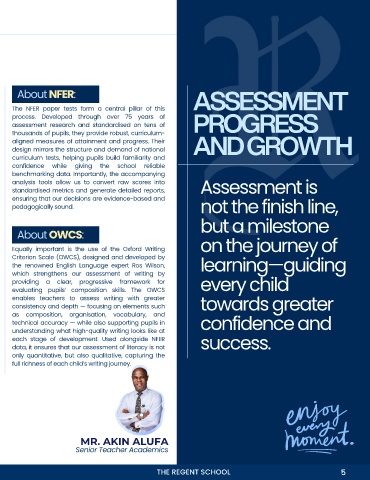
 in  the  academic  year.  While  GL  assessments  child  continues  to  progress  with  confidence  and  MR. AKIN ALUFA
 provide  external  benchmarking  and  standardised  purpose into Term 3.  Senior Teacher Academics
 comparisons

 THE REGENT SCHOOL  4                                THE REGENT SCHOOL                                            5

