


Page 36 - 01. Gi_February2018_LowRes
P. 36
IGEM NEWS | Young Persons Paper Competition 2017
PERSONAL CONTRIBUTION Technical learning: Control of Major
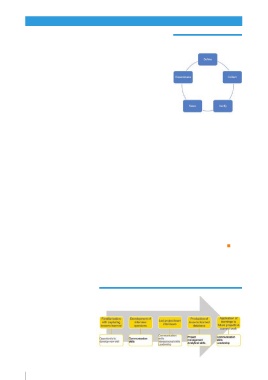
AND DEVELOPMENT Accidents Hazards FIGURE 5. Process of capturing lessons
I was responsible for collating lessons (COMAH) regulations learned
learned from the PCCS project team. The application of UK Control of
As part of my role, I developed Major Accidents Hazards (COMAH)
specic interview questions and regulations was identied as a FOAK
subsequently led project team element for the PCCS Project. The
interviews, primarily on a one-on-one Peterhead Power Station site is not
basis, but also in a group setting currently a COMAH site, but
where relevant. I then reviewed, implementation of the capture plant
veried, and stored the learnings would result in the site meeting
captured from the team in a database, COMAH classication. An
with opportunities taken to amendment to COMAH regulation in
disseminate the learnings where 2015 coincided with FEED, and led to
possible. The opportunity to take on evolutions in the project design, with
this role allowed me to develop a new the learning that COMAH-associated
skill in the form of capturing lessons design challenges should be
learned, and also to enhance my identied from the outset of FEED to
communication, project management, mitigate any impacts on project CONCLUSIONS
and leadership skills (Figure 6). schedule. Lessons learned from the PCCS
project have been captured, stored
LEARNINGS CAPTURED FROM Commercial learning: contract for and disseminated. The learnings have
THE PCCS PROJECT di
erence identied best practices to be applied
Multiple learnings were captured In the UK, the electricity market to future CCS project design and
from the PCCS project, covering a reform (ERM) stipulates a contract construction to optimise technology
range of topics including technical, for dierence (CfD) to guarantee a development, enhance eciencies,
commercial and stakeholder pre-dened price per MWh (‘strike and in turn reduce costs. This will
engagement. Examples of such price’) to the generator for support eorts to increase the
learnings are provided below. production of low carbon electricity. cost-competitiveness of CCS to
The key learning was that due to the maximise deployment of the
Technical learning: emissions to air integrated nature of the PCCS technology, and in turn help facilitate
Given the nature of the amine project with the existing power global net zero emissions from energy,
2
sorbent to be used within the CO station, quantication and metering including natural gas-derived sources,
capture plant, atmospheric emissions was required to accurately measure, near the end of this century.
of amines and degradation products monitor and report production of low
were addressed and several design carbon power for the CfD. ACKNOWLEDGEMENTS
features incorporated to minimise The author wishes to acknowledge
such emissions to air. Stakeholder engagement the Shell Peterhead CCS project team
Atmospheric dynamic dispersion and public consultation for their dedicated time, help and
modelling using ADMS soware was The importance of open discussions support in capturing the lessons
undertaken to conrm emissions between the PCCS project team and learned from the project, and also
levels of amines and their stakeholders was key to regulators wishes to acknowledge Shell for the
degradation compounds. Input data and communities having trust and opportunity to lead the work. ■
to the model was agreed with the condence in the project, which in
regulator, and results indicated that turn was of importance for the References
amine and degradation compound approval of planning permission for Rubin, ES, Yeh, S, Hounshell, DA 2004, “Experience
curves for power plant emission control
emissions would be below required the project. technologies”, The International Journal of Energy
emissions limits, and would comply Technology and Policy, pp. 52-69.
with relevant environmental
assessment levels (EAL). In addition,
operational testing of the amine
formulated for the PCCS project was
undertaken at the world’s largest FIGURE 6. Personal contribution and development
2
CO capture test plant, Technology
Centre Mongstad (TCM).
Learnings from this work, including
the TCM campaign, conrmed the
PCCS project design was t for
purpose and no design change was
required for emissions purposes as
regulatory requirements would be
met. This too underlined the
importance of large scale
capture testing.
36
IGEMNews_YPPC.indd 3 18/01/2018 12:24

