


Page 28 - aruba-today-20180317
P. 28
A28 SCIENCE
Saturday 17 March 2018
Snow science: Crystal clues to climate change, watersheds
By MICHAEL HILL tica and has studied snow
HIGHMOUNT, N.Y. (AP) — hydrology in the Rock-
Capturing snowflakes isn't ies and the Dolomites. He
as easy as sticking out your said snow in the Eastern
tongue. U.S. has its own character.
At least not when you're It tends to be moister than
trying to capture them for the powdery snow that falls
scientific study, which in- in higher elevation in the
volves isolating the tiniest West. Tedesco hopes that
of crystals on a metal card a cadre of committed vol-
printed with grid lines and unteers in the Catskills and
quickly placing them under the New York City area can
a microscope to be photo- take snowflake and snow
graphed. depth samples next win-
"They are very tiny and they ter. Volunteers won't need
are close to the melting an expensive backpack
point," Marco Tedesco of spectrometer, but he rec-
Columbia University said as ommends a $17 magnify-
he set up his microscope ing lens that clips onto their
beside a snowy field. "So as phone, a ruler, a GPS appli-
soon as they fall, they will cation and a print-out ver-
melt." Tedesco recently led sion of the postcard-sized
a team of three research- metal card Tedesco uses to
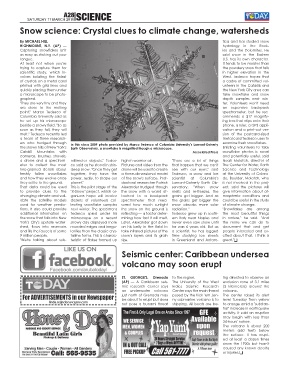
ers who trudged through In this circa 2009 photo provided by Marco Tedesco of Columbia University's Lamont-Doherty examine fresh snowflakes.
the snowy hills of New York's Earth Observatory, a snowflake is magnified though a microscope. Enlisting volunteers to take
Catskill Mountains with Associated Press snowflake photos is novel
cameras, brushes, shovels, and potentially useful, said
a drone and a spectrom- millimeter objects," Tedes- high in warmer air. "There are a lot of things Noah Molotch, director of
eter to collect the most co said as he stood in shin- Pictures and video from the that happen that we can't The Center for Water, Earth
fine-grained details about deep snow. "Once they get drone will be used to create see with our eyes," said Science and Technology
freshly fallen snowflakes together, they have the a three-dimensional model Tedesco, a snow and ice at the University of Colora-
and how they evolve once power, really, to shape our of the snow's surface. Post- scientist at Columbia's do, Boulder. Molotch, who
they settle to the ground. planet." doctoral researcher Patrick Lamont-Doherty Earth Ob- is not involved in the proj-
That data could be used This is the pilot stage of the Alexander trudged though servatory. "When snow ect, said the pictures will
to provide clues to the "X-Snow" project, which or- the snow with a wand at- melts and re-freezes, the give information about at-
changing climate and vali- ganizers hope will involve tached to a backpack grains get bigger. And as mospheric conditions and
date the satellite models dozens of volunteers col- spectrometer that mea- the grains get bigger the could be useful in the study
used for weather predic- lecting snowflake samples sured how much sunlight snow absorbs more solar of climate change.
tions. It also could provide next winter. The specimens the snow on the ground is radiation." "Snowflakes are among
additional information on Tedesco spied under his reflecting — a factor deter- Tedesco grew up in south- the most beautiful things
the snow that falls into New microscope on a recent mining how fast it will melt. ern Italy near Naples and in nature," he said. "And
York's City's upstate water- snowy day displayed more Later, Alexander got down never even saw snow until the more we can do to
shed, flows into reservoirs rounded edges and irregu- on his belly in the field to he was 6 years old. But as document that and get
and fills the faucets of some larities than the classic crys- take infrared pictures of the a scientist, he has logged people interested and ex-
9 million people. talline forms. This is charac- snow's layers and its grain time studying ice sheets cited about that, I think is
"We're talking about sub- teristic of flakes formed up size. in Greenland and Antarc- great."q
Seismic center: Caribbean undersea
volcano may soon erupt
ST. GEORGE'S, Grenada to the region. ing directed to observe an
(AP) — A Caribbean seis- The University of the West exclusion zone of 3.1 miles
mic research center says Indies Seismic Research (5 kilometers) around the
an underwater volcano Center says the main threat volcano.
just north of Grenada may posed by the Kick 'em Jen- The center raised its alert
be about to erupt but does ny submarine volcano is to level Tuesday from yellow
not pose a tsunami threat shipping. All boats are be- to orange amid a "substan-
tial" increase in earthquake
activity. It said an eruption
may begin with less than
24-hours' notice.
The volcano is about 200
meters (660 feet) below
the surface. It has erupt-
ed at least a dozen times
since the 1930s but hasn't
caused any known deaths
or injuries.q

