


Page 32 - ARUBA TODAY
P. 32
A32    FEATURE
                         Friday 1 June 2018
            Skyping the doctor? Poll shows it's not just for the young


            By LAURAN NEERGAARD                                                                                                 Cortland,  New  York,  who
            EMILY SWANSON                                                                                                       helps his 92-year-old father
            Associated Press                                                                                                    and  89-year-old  mother
            WASHINGTON (AP) — Every                                                                                             get  to  their  appointments.
            morning,  92-year-old  Sid-                                                                                         But,  "we  don't  know  much
            ney Kramer wraps a blood                                                                                            more  about  it  other  than
            pressure  cuff  around  his                                                                                         the fact you can talk to a
            arm and steps on a scale,                                                                                           doctor  over  the  computer
            and  readings  of  his  heart                                                                                       or smartphone."
            health beam to a team of                                                                                            Just  12  percent  of  adults
            nurses — and to his daugh-                                                                                          say  they  wouldn't  use  any
            ter's  smartphone  —  miles                                                                                         form of telemedicine.
            from his Maryland home.                                                                                             There  are  concerns.  More
            Red flags?  A nurse imme-                                                                                           than 30 percent of people
            diately calls, a form of tele-                                                                                      worry about privacy or the
            medicine  that  is  helping                                                                                         security  or  health  informa-
            Kramer  live  independently                                                                                         tion.  About  half  fear  that
            by  keeping  his  congestive                                                                                        telemedicine could lead to
            heart  failure  under  tight                                                                                        lower-quality care, the poll
            control.                                                                                                            found.
            "It's reassuring both psycho-                                                                                       "It's  not  about  having  a
            logically  and  physically.                                                                                         video  screen  or  Skype  in
            The  way  he's  put  it  to  me,                                                                                    the home or even a blood
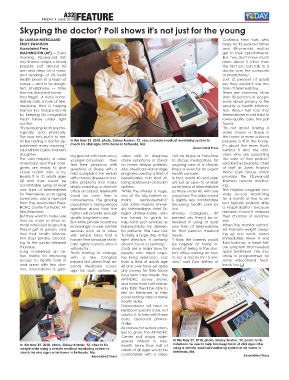
            it's like having a doctor ap-  In this May 29, 2018, photo, Sidney Kramer, 92, uses a remote medical monitoring system to   pressure  cuff  in  the  home.
            pointment  every  morning,"   check his vital signs at his home in Bethesda, Md.                   Associated Press  It's  about  the  team  that's
            said Miriam Dubin, Kramer's                                                                                         behind  it  and  the  clini-
            daughter.                    ing ground with tech-savvy  video  visits  to  diagnose  visit via Skype or FaceTime   cians  who  are  supporting
            The  vast  majority  of  older   younger consumers — they  stroke  symptoms  or  check  to  discuss  medications,  for   the  care  of  that  patient,"
            Americans  and  their  care-  text  their  physician  with  on  home  dialysis  patients.  ongoing care of a chronic   said Rachel DeSantis, chief
            givers  are  ready  to  give   questions  or  Skype  with  a  Also, Medicare Advantage  illness or even for an urgent   of  staff  at  Johns  Hopkins
            virtual  health  care  a  try:   mild  complaint.  For  seniors  programs used by a third of  health concern.       Home  Care  Group,  which
            Nearly  9  in  10  adults  ages   with chronic illnesses or mo-  beneficiaries  can  start  of-  In fact, adults 40 and older   provides  the  92-year-old
            40  and  over  would  be     bility  problems  that  make  fering additional telehealth  are just as open to at least   Kramer's  remote  monitor-
            comfortable  using  at  least   simply  reaching  a  doctor's  options.                some forms of telemedicine   ing.
            one  type  of  telemedicine   office an ordeal, telehealth  "While  the  interest  is  huge,  as those under 40, with one   The  Hopkins  program  pro-
            for themselves or an aging   could  be  more  than  a  one  of  the  big  barriers  re-  exception: The older crowd   vides  no-cost  monitoring
            loved one, says a new poll   convenience.  The  graying  mains       reimbursement,"  is  slightly  less  comfortable   for  a  month  or  two  to  se-
            from  The  Associated  Press-  population is raising serious  said  Johns  Hopkins  Univer-  discussing  health  care  by   lect  high-risk  patients  after
            NORC Center for Public Af-   questions  about  how  the  sity  telemedicine  chief  Dr.  text.                      a  hospitalization  because
            fairs Research.              nation will provide enough  Ingrid  Zimmer-Galler,  who  Among      caregivers,   87   research  found  it  reduces
            But they want to make sure   quality long-term care.      has  turned  to  grants  to  percent  say  they'd  be  in-  their  chances  of  readmis-
            that  an  e-visit  or  other  re-  But while private insurance  help  fund  such  services  as  terested  in  using  at  least   sion.
            mote care is just as good as   increasingly  covers  certain  telepsychiatry  for  demen-  one  form  of  telemedicine   When  the  monitor  record-
            they'd  get  in  person,  and   services  such  as  a  video  tia  patients.  The  new  law  for  that  person's  medical   ed Kramer's weight creep-
            that  their  health  informa-  visit,  seniors  have  had  a  "is really a huge step in the  needs.                 ing  up  one  week,  nurses
            tion  stays  private,  accord-  harder time because Medi-  right  direction.  It  certainly  "I  think  the  parents  would   immediately  knew  it  was
            ing  to  the  survey  released   care tightly restricts what it  doesn't cover everything."  be  happier  at  home  in-  fluid  build-up,  a  heart  fail-
            Thursday.                    will pay for.                Costs are a major issue for  stead of being in the doc-   ure symptom that needed
            Long  considered  an  op-    That's  starting  to  change,  people  who  need  ongo-   tor's office waiting an hour   quick  treatment.  The  ma-
            tion  mainly  for  improving   with   a   law   Congress  ing  living  assistance.  Less  to see a doctor for 15 min-  chine  is  programmed  for
            access  to  health  care  in   passed  last  winter  that  ex-  than  a  third  of  adults  age  utes,"  said  Don  Withey  of   some  educational  feed-
            rural  areas  with  few  doc-  pands  Medicare  cover-    40 and over have set aside                                back, too.q
            tors,  telemedicine  is  gain-  age  for  such  options  as  any  money  for  their  future
                                                                      long  term  care  needs,  the
                                                                      AP-NORC  survey  shows,
                                                                      and more than half mistak-
                                                                      enly think they'll be able to
                                                                      rely  on  Medicare  to  help
                                                                      cover nursing care or home
                                                                      health aides.
                                                                      Telemedicine  will  have  to
                                                                      replace in-person care, not
                                                                      add to it, to help with those
                                                                      costs,  cautioned  Zimmer-
                                                                      Galler.
                                                                      As access for seniors prom-
                                                                      ises to grow, the AP-NORC
                                                                      Center  poll  shows  wide-
                                                                      spread  interest  in  tele-   In this May 29, 2018, photo, Sidney Kramer, 92, points to his
             In this May 29, 2018, photo, Sidney Kramer, 92, checks his   health.  More  than  half  of   notebook he uses to help him keep track of vital signs after
             weight while using a remote medical monitoring system to   adults of all ages would be   using a remote medical monitoring system at his home in
             check his vital signs at his home in Bethesda, Md.                                     Bethesda, Md.
                                                     Associated Press  comfortable  with  a  video                                          Associated Press

