


Page 16 - ARUBA TODAY
P. 16
A16 FEATURE
Friday 14 July 2017
Met exhibit looks at Japan’s fine craft of bamboo basketry
By KATHERINE ROTH Although the oldest Japa- But it was not until the late
Associated Press nese baskets date to the 19th century, the exhibit
NEW YORK (AP) — Bamboo 700s and were mainly used explains, that bamboo
is getting attention these as offering trays and hold- craftsmanship began to
days as a versatile and ers for lotus petals, there be recognized as, first, a
sustainable material for was little focus on Japa- veritable Japanese deco-
housewares, so the timing nese bamboo art in the rative art and, later, as a
is good for a Metropolitan Western world until rela- bona fide art form. Later
Museum of Art exhibit that tively recently, Bincsik says. masters such as Iizuka Ro-
explores Japan’s ancient Most of the works featured kansai created innovative
craft of basketry. in this show are taken from works that were the foun-
“Japanese Bamboo Art: the Diane and Arthur Ab- dation for contemporary
The Abbey Collection” is bey Collection, and most bamboo art.
devoted to masterworks, have never before been The show includes textiles
including a half dozen shown to the public. More passed from bamboo bas-
works by two artists desig- than 70 of the works exhib- ketry mentors to their stu-
nated as Living National ited were recently prom- dents as a sort of diploma,
Treasures in Japan. To ised as gifts to the Met. or graduation gift, signal-
highlight the works’ virtuos- The show opens with a ing an apprentice’s eleva-
ity and context, they have dramatically curvaceous tion to the rank of skilled
been displayed along- floor-to-ceiling sculpture craftsman. These precious
side paintings, ceram- by master craftsman Ta- textiles were passed down
ics, bronzes, kimonos and nabe Chikuunsay IV. With time and again over gen-
other pieces from different its voluptuous shape, the erations.
genres. site-specific piece is woven Most of the exhibit is orga-
The exhibit also explores out of rare tiger bamboo, nized geographically into
other traditional Japanese which is mottled with dark three major Japanese re-
arts that are entwined with spots. gions; Kansai (mainly Kyoto
bamboo basketry, such The introductory section and Osaka), Kanto (mainly
as ikebana flower arrang- shows how bamboo was Tokyo) and the southern
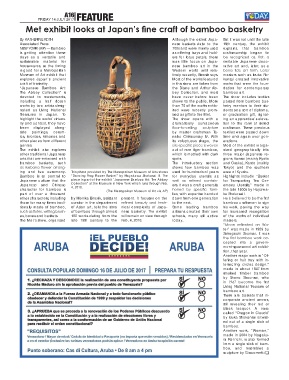
ing and tea ceremony. This photo provided by The Metropolitan Museum of Arts shows used for hundreds of years area of Kyushu.
Bamboo is so central to “Dancing Frog Flower Basket” by Hayakawa Shokosai III. The for everyday utensils as Highlights include “Basket
Japanese culture that the piece is part of the exhibit “Japanese Bamboo Art: The Abbey well as refined contain- for Transporting Tea Cer-
Japanese and Chinese Collection” at the Museum in New York which runs through Feb. ers. It was a craft generally emony Utensils,” made in
4, 2018.
character for bamboo is (The Metropolitan Museum of Art via AP) honed by specific fami- the late 1800s by Hayawa-
part of over a thousand lies, with expertise handed ka Shokosai I.
other characters, including by Monika Bincsik, assistant present. It focuses on the down from one generation He is believed to be the first
those for many items tradi- curator in the department refined beauty and tech- to the next. bamboo craftsman to sign
tionally made of bamboo, of Asian art, tells the story nical complexity of Japa- Some leading bamboo his work, paving the way
such as flutes, writing brush- of bamboo through almost nese basketry. The exhibit artisans created their own for increased recognition
es, boxes and baskets. 100 works dating from the will remain on view through schools, many still active of the works of individual
The Met’s show, organized late 19th century to the Feb. 4, 2018. today. masters.
“Moon reflected on Wa-
ter” was made in 1929 by
Sakaguchi Sounsai. It was
the first bamboo work ac-
cepted into a govern-
ment-sponsored art exhibi-
tion, that year.
Another major work is “Of-
fering or fruit tray with in-
tersecting circles design,”
made in about 1947 from
smoked timber bamboo
by Shono Shounsai, who
in 1967 become the first
Living National Treasure of
bamboo art.
There are baskets that in-
corporate ancient arrows,
still revealing their red or
black lacquer. A vase
called “Dragon in Clouds”
by Iizuka Shokansai is twist-
ed out of a single stick of
bamboo.
Another work, “Woman,”
made in 2004 by Nagaku-
ra Ken’ichi, is also formed
from a single stick of bam-
boo, and resembles a
sculpture by Giacometti.q

