


Page 14 - AHATA
P. 14
a11
                                                                                                           local Tuesday 18 November 2025
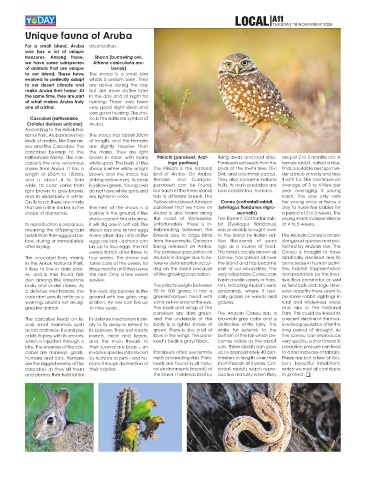
            Unique fauna of Aruba


            For  a  small  island,  Aruba  urbanization.
            sure  has  a  lot  of  unique
            treasures.  Among  these,       Shoco (burrowing owl,
            we have some subspecies        Athene cunicularia aru-
            of animals that are unique             bensis)
            to  our  island.  These  have  The  shoco  is  a  small  bird
            evolved to perfectly adapt  which is seldom seen. They
            to  our  desert  climate  and  are  active  during  the  day
            make Aruba their home. At  but  are  more  active  later
            the same time, they are part  in the day and at night for
            of what makes Aruba truly  hunting.  These  owls  have
            one of a kind.               very good night vision and
                                         very good hearing. The sho-
               Cascabel (rattlesnake,    co is the national symbol of
             Crotalus durissus unicolor)  Aruba.
            According to the Arikok Na-
            tional Park, Aruba knows two  The shoco has about 20cm
            kinds of snakes, the Santan-  of length, and the females
            ero and the Cascabel. The  are  slightly  heavier  than
            cascabel  belongs  to  the  the  males.  They  are  light
            rattlesnake family. The cas-  brown  in  color,  with  many   Prikichi (parakeet, Arat-  flying away and loud cries.  are just 2 to 3 months old. A
            cabel is the only venomous  white spots. The belly of the       inga pertinax)         Parakeets eat seeds from the  female rabbit, called a doe,
            snake from Aruba. It has a  shoco is either white or light  The  Prikichi  is  the  national  pods of the Kwihi tree, Divi  finds a suitable nest spot un-
            length  of  65cm  to  100cm,  brown, and the shoco has  bird  of  Aruba.  On  Aruba,  Divi, and columnar cactus.  der a shrub or rocks and lines
            and  is  about  4  to  5cm  striking yellow eyes. Its beak  Bonaire,   and   Curaçao,  They also consume natural  it with fur. She can have an
            wide.  Its  color  varies  from  is yellow/green. Young owls  parakeets  can  be  found,  fruits. Its main predators are  average of 3 to 4 liters per
            light brown to grey-brown,  do not have white spots and  but each of the three islands  boa constrictors, humans.   year  averaging  5  young
            and its underbelly is white.  are lighter in color.       has  a  different  breed.  The                            each.  The  doe  only  visits
            On its back there are marks                               Yellow-shouldered Amazon      Coneu (cottontail rabbit,   her young once or twice a
            that are a little darker, in the  The  nest  of  the  shoco  is  a  parakeet that we have on   Sylvilagus floridanus nigro-  day to nurse her babies for
            shape of diamonds.           burrow in the ground. If the  Aruba  is  also  found  along        nuchalis)           a period of 2 to 3 weeks. The
                                         shoco cannot find a burrow,  the  coast  of  Venezuela.  The Eastern Cottontail rab-   young reach independence
            Its reproduction is oviparous,  it will dig one in soft soil. The  Unfortunately,  there  is  in-  bit  (Sylvilagus  floridanus)  at 4 to 5 weeks.
            meaning the offspring can  shoco lays one or two eggs  terbreeding  between  the  was probably brought over
            hatch from their eggs just be-  every other day until all the  breeds  due  to  cage  birds  to the island by Indian set-  The Aruban Coneu is an en-
            fore, during or immediately  eggs are laid – a shoco can  from, for example, Curaçao  tlers  thousands  of  years  dangered species and pro-
            after laying.                lay up to four eggs. The first  being  released  on  Aruba.  ago  as  a  source  of  food.  tected by Aruban law. The
                                         owlets hatch after three to  The parakeet population on  This rabbit, locally known as  Coneu  is  thought  to  have
            The  cascabel  lives  mainly  four  weeks.  The  shoco  owl  Aruba is in danger due to ex-  Coneu, has spread all over  drastically declined due to
            in the Arikok National Park.  takes care of the owlets for  tensive deforestation occur-  the island and has become  an increase in human activi-
            It  likes  to  live  in  dark  plac-  three months until they leave  ring on the island because  part of our ecosystem. The  ties, habitat fragmentation
            es,  and  is  thus  found  hid-  the nest. Only a few owlets  of the growing population.  very adaptable Coneu can  and predation by the inva-
            den  among  the  limestone  survive.                                                   live in a wide variety of habi-  sive Boa constrictor as well
            rocks and under stones. As                                The prikichi weighs between  tats, including Aruba’s xeric  as feral cats and dogs. How-
            a defense mechanism, the  The owls dig burrows in the  90  to  100  grams.  It  has  a  scrublands,  where  it  typi-  ever, recently there seem to
            cascabel uses its rattle as a  ground with low grass veg-  greenish-brown  head  with  cally grazes on weeds and  be more rabbit sightings in
            warning, and it is not an ag-  etation. An owl can live up  some yellow around the eye.  grasses.                   rural  and  wilderness  areas
            gressive animal.             to nine years.               The back and wings of the                                 and  also  in  the  National
                                                                      parakeet  are  dark  green,  The  Aruban  Coneu  has  a  Park. This could be linked to
            The  cascabel  feeds  on  liz-  Its defense mechanism is sim-  and  the  underside  of  the  brownish grey color and a  a recent decline of the inva-
            ards,  small  mammals  such  ply to fly away or retreat to  body  is  a  lighter  shade  of  distinctive  white  belly.  This  sive Boa population after the
            as rats and mice. It paralyzes  its burrows. They eat mostly  green. There is also a bit of  white  fur  extends  to  the  long period of drought. As
            or kills its prey with its venom,  insects,  mice  and  lizards,  blue in the wings. The para-  bottom of the tail which be-  the Coneu can reproduce
            which is injected through a  and  the  main  threats  to  keet’s beak is gray/black.   comes visible as the rabbit  very quickly, a short break in
            bite. The enemies of the cas-  their survival are boas – an                            runs. These rabbits can grow  predation pressure can lead
            cabel  are  donkeys,  goats,  invasive species introduced  Parakeets often use termite  up to approximately 40 cen-  to a fast increase of rabbits.
            humans and cars. Humans  by humans as pets – and hu-      nests as breeding sites. Para-  timeters in length over their  These are but a few of Aru-
            are the biggest enemy of the  mans through destruction of  keets are found in all natu-  short lifespan of 3 years. Cot-  ba’s  beautiful  inhabitant,
            cascabel, as they kill them  their habitat.               ral environments (mondi) of  tontail rabbits reach repro-  which we must all contribute
            and destroy their habitat for                             the island. It defends itself by  ductive maturity when they  to protect. q

