


Page 28 - ARUBA TODAY
P. 28
A28 SCIENCE
Friday 2 March 2018
Astronomers glimpse cosmic dawn, when the stars switched on
By SETH BORENSTEIN tablish exactly when these
AP Science Writer stars turned on, except
WASHINGTON (AP) — For that at 180 million years af-
the first time, astronomers ter the Big Bang, they were
have glimpsed the dawn on. Scientists had come up
of the universe 13.6 billion with many different time
years ago when the earliest periods for when the first
stars were just beginning to stars switched on, and 180
glow after the Big Bang. million years fits with cur-
And if that’s not enough, rent theory, said Ellis, a pro-
they may have detected fessor at University College
mysterious dark matter at London.
work, too. When this signal was found
The glimpse consisted of a and examined, it showed
faint radio signal from deep that the hydrogen be-
space, picked up by an tween stars was “even
antenna that is slightly big- colder than the coldest
ger than a refrigerator and we thought possible,” said
costs less than $5 million Rennan Barkana, a Tel Aviv
but in certain ways can go University astrophysicist
back much farther in time who wrote a companion
and distance than the cel- study on the dark matter
ebrated, multibillion-dollar implications of the discov-
Hubble Space Telescope. ery deserves two Nobel black and cold, filled with would be like trying to hear ery. The researchers ex-
Judd Bowman of Arizona Prizes” for both capturing just hydrogen and helium. the flap of a hummingbird’s pected temperatures to
State University, lead au- the signal of the first stars Once stars formed, they wing from inside a hurri- be 10 degrees above ab-
thor of a study in Wednes- and potential dark matter emitted ultraviolet light into cane,” Kurczynski said in an solute zero, but they were
day’s journal Nature, said confirmation, said Harvard the dark areas between NSF video. 5 degrees above absolute
the signal came from the astronomer Avi Loeb, who them. That ultraviolet light Because the high end of zero (minus 451 degrees
very first objects in the uni- wasn’t part of the research changes the energy sig- the frequency they were Fahrenheit, or minus 268
verse as it was emerging degrees Celsius).
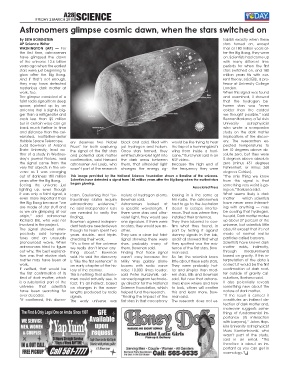
out of darkness 180 million This image provided by the National Science Foundation shows a timeline of the universe. “The only thing we know
years after the Big Bang. Scientists have detected a signal from 180 million years after the Big Bang when the earliest stars from this signal is that
Seeing the universe just began glowing. Associated Press something very weird is go-
lighting up, even though ing on,” Barkana said.
it was only a faint signal, is team. Cautioning that “ex- nature of hydrogen atoms, looking in is the same as What seems likely is dark
even more important than traordinary claims require Bowman said. FM radio, the astronomers matter — which scientists
the Big Bang because “we extraordinary evidence,” Astronomers looked at had to go to the Australian have never seen interact-
are made of star stuff and he said independent tests a specific wavelength. If desert to escape interfer- ing with anything — may
so we are glimpsing at our are needed to verify the there were stars and ultra- ence. That was where they be cooling that hydrogen,
origin,” said astronomer findings. violet light, they would see installed their antennas. he said. Dark matter makes
Richard Ellis, who was not Bowman agreed indepen- one signature. If there were They then labored to con- up about 27 percent of the
involved in the project. dent tests are needed even no stars, they would see an- firm what they found, in universe, but scientists little
The signal showed unex- though his team spent two other. part by testing it against about it except that it’s not
pectedly cold tempera- years double- and triple- They saw a clear but faint dummy signals in the lab, made of normal matter
tures and an unusually checking their work. signal showing there were and it all showed that what particles called baryons.
pronounced wave. When “It’s a time of the universe stars, probably many of they spotted was the exis- Scientists have known dark
astronomers tried to figure we really don’t know any- them, Bowman said. tence of the first stars, Bow- matter exists, indirectly,
out why, the best explana- thing about,” Bowman Finding that trace signal man said. through measurements
tion was that elusive dark said. He said the discovery wasn’t easy because the So far, the scientists know based on gravity. If this in-
matter may have been at is “like the first sentence” in Milky Way galaxy alone little about these early stars. terpretation of the data is
work. an early chapter of the his- booms with radio wave They were probably hot- correct, it would be the first
If verified, that would be tory of the cosmos. noise 10,000 times louder, ter and simpler than mod- confirmation of dark mat-
the first confirmation of its This is nothing that astrono- said Peter Kurczynski, ad- ern stars, Ellis and Bowman ter outside of gravity cal-
kind of dark matter, which mers could actually see. In vanced program technolo- said. But now that astrono- culations, Barkana said.
is a substantial part of the fact, it’s all indirect, based gy director for the National mers know where and how It also potentially reveals
universe that scientists on changes in the wave- Science Foundation, which to look, others will confirm something new about the
have been searching for lengths produced by radio helped fund the research. this and learn more, Bow- nature of dark matter.
over decades. signals. “Finding the impact of the man said. “If the result is correct it
“If confirmed, this discov- The early universe was first stars in that cacophony The research does not es- constitutes an indirect de-
tection of dark matter and,
moreover suggests some-
thing of fundamental im-
portance (its interaction
with baryons),” Johns Hop-
kins University astrophysicist
Marc Kamionkowski, who
wasn’t part of the study,
said in an email. “This
therefore is about as im-
portant as you can get in
cosmology.”q

