


Page 21 - AB
P. 21
a11
                                                                                                           local Monday 17 noveMber 2025
            The history and meaning of the Aruban florin


            (Oranjestad)—Aruba  Today  loves
            to share parts of the Aruban culture
            with our readers, diving into (histor-
            ical) facts of Aruba, its culture and
            way  of  living.  In  this  article,  we’ll
            look at the Aruban florin: its history,
            design and symbolism.

            In  Aruba,  we  know  the  5,  10,  25
            and 50 cent coins, along with the
            1  and  5  Florin  coin.  Aruban  Florin
            bills include the 10, 25, 50, 100, and
            rarely, the 200 bills. In Papiamento
            we call our currency Florin, but the
            umbrella term for money is ‘placa’.
            Cents  are  called  ‘cen’  (pro-
            nounced: seng), both in the singu-
            lar and plural form. Most coins are
            circular  and  their  size  depend  on
            their  worth.  However,  the  50  cent
            coin is easily recognizable by their
            square shape, as is the 5 Florin coin
            by  their  golden  color.  Every  coin
            has  the  Aruban  emblem  carved
            on it, with the other side displaying
            the worth of the coin. The bigger 1
            and  5  florin  coins,  however,  con-
            tain the carving of the emblem on
            one side, while displaying the side
            profile of the Dutch king, Willem-Al-  ued.                             Tortuga  blanco  (white  turtle).  The
            exander, on the other side. When                                        blue color symbolizes the blue Ca-  50 florin
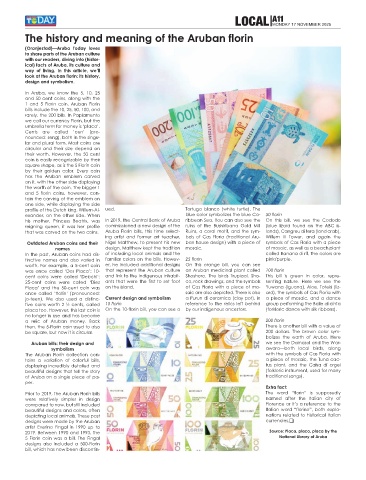
            his  mother,  Princess  Beatrix,  was  In 2019, the Central Bank of Aruba  ribbean Sea. You can also see the  On  this  bill,  we  see  the  Cododo
            reigning  queen,  it  was  her  profile  commissioned a new design of the  ruins  of  the  Bushiribana  Gold  Mill  (blue  lizard  found  on  the  ABC  is-
            that was carved on the two coins.   Aruba  Florin  bills,  this  time  select-  Ruins, a coral motif, and the sym-  lands), Cangreu di tera (land crab),
                                                ing  artist  and  former  art  teacher,  bols  of  Cas  Floria  (traditional  Aru-  Willem  III  Tower,  and  again  the
             Outdated Aruban coins and their    Nigel Matthew, to present his new  ban house design) with a piece of  symbols of Cas Floria with a piece
                          names                 design. Matthew kept the tradition  mosaic.                             of mosaic, as well as a beach plant
            In the past, Aruban coins had dis-  of including local animals and the                                      called Banana di rif. The colors are
            tinctive  names  and  also  varied  in  familiar colors on the bills. Howev-  25 florin                     pink/purple.
            worth. For example, a 5-cent coin  er, he included additional designs  On  this  orange  bill,  you  can  see
            was  once  called  ‘Dos  Placa’;  10-  that represent the Aruban culture  an Aruban medicinal plant called  100 florin
            cent  coins  were  called  ‘Debchi’;  and link to the Indigenous inhabit-  Shoshoro.  The  birds  Trupiaal,  Sho-  This  bill  is  green  in  color,  repre-
            25-cent  coins  were  called  ‘Diez  ants that were the first to set foot  co, rock drawings, and the symbols  senting  nature.  Here  we  see  the
            Placa’  and  the  50-cent  coin  was  on the island.                    of  Cas  Floria  with  a  piece  of  mo-  Yuwana (Iguana), Aloe, Toteki (liz-
            once  called  ‘Yotin’  (pronounced:                                     saic are also depicted. There is also  ard), the symbols of Cas Floria with
            jo-teen).  We  also  used  a  distinc-  Current design and symbolism    a Purun di ceramica (clay pot), in  a  piece  of  mosaic,  and  a  dance
            tive coins worth 2 ½ cents, called  10 florin                           reference to the relics left behind  group performing the Baile di cinta
            placa too. However, this last coin is  On the 10-florin bill, you can see a  by our indigenous ancestors.   (forkloric dance with silk ribbons).
            no longer in use and has become
            a  relic  of  Aruban  money.  Back                                                                          200 florin
            then, the 5-Florin coin used to also                                                                        There is another bill with a value of
            be square, but now it is circular.                                                                          200  dollars.  The  brown  color  sym-
                                                                                                                        bolizes  the  earth  of  Aruba.  Here
               Aruban bills: their design and                                                                           we see the Dornasol and the War-
                        symbolism                                                                                       awara—both  local  birds,  along
            The  Aruban  Florin  collection  con-                                                                       with the symbols of Cas Floria with
            tains  a  variation  of  colorful  bills,                                                                   a piece of mosaic, the Tuna cac-
            displaying incredibly detailed and                                                                          tus  plant,  and  the  Caha  di  orgel
            beautiful designs that tell the story                                                                       (folkloric instrument, used for many
            of Aruba on a single piece of pa-                                                                           traditional songs).
            per.
                                                                                                                        Extra fact:
            Prior to 2019, the Aruban Florin bills                                                                      The  word  “florin”  is  supposedly
            were  relatively  simpler  in  design                                                                       named  after  the  Italian  city  of
            compared to now, but still included                                                                         Florence or it’s a reference to the
            beautiful designs and colors, often                                                                         Italian  word  “florino”,  both  expla-
            depicting local animals. These past                                                                         nations related to historical Italian
            designs were made by the Aruban                                                                             currencies.q
            artist  Everino  Fingal  in  1990  up  to
            2019. Between 1990 and 1993, the                                                                              Source: Placa, placa, placa by the
            5  Florin  coin  was  a  bill.  The  Fingal                                                                       National Library of Aruba
            designs  also  included  a  500-Florin
            bill, which has now been discontin-

