


Page 32 - ARUBA TODAY
P. 32
A32 FEATURE
Wednesday 13 september 2017
NASA’s Saturn-orbiting Cassini spacecraft faces fiery finish
By MARCIA DUNN orbited Saturn nearly 300
AP Aerospace Writer times and collected more
CAPE CANAVERAL, Fla. than 453,000 pictures and
(AP) — After a 20-year voy- 635 gigabytes of scientific
age, NASA’s Cassini space- data.
craft is poised to dive into The European Space
Saturn this week to be- Agency’s Huygens lander
come forever one with the — which hitchhiked all the
exquisite planet. way to Saturn aboard Cas-
There’s no turning back: Fri- sini — still rests on Titan.
day it careens through the It parachuted down in
atmosphere and burns up 2005, about six months af-
like a meteor in the sky over ter Cassini arrived at Sat-
Saturn. urn, and relayed data for
NASA is hoping for scien- more than an hour from
tific dividends up until the the moon’s frigid surface.
end. Every tidbit of data Still believed intact, Huy-
radioed back from Cassini gens remains the only
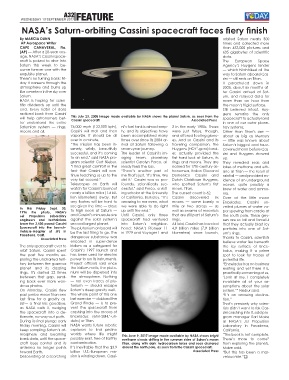
will help astronomers bet- This July 23, 2008 image made available by NASA shows the planet Saturn, as seen from the spacecraft to actually land
Associated Press
Cassini spacecraft.
ter understand the entire in one of our outer plane-
Saturnian system — rings, 76,000 mph (122,000 kph), ni’s fuel tank is almost emp- 2 in the early 1980s. Those tary systems.
moons and all. Cassini will melt and then ty, and its objectives have were just flybys, though, Other than Titan’s size —
vaporize. It should be all been accomplished many and offered fleeting glanc- about as big as Mercury
over in a minute. times over since its 2004 ar- es. And so Cassini and its — little was known about
“The mission has been in- rival at Saturn following a traveling companion, the Saturn’s biggest and haze-
sanely, wildly, beautifully seven-year journey. Huygens (HOY’-gens) land- covered moon before Cas-
successful, and it’s coming The leader of Cassini’s im- er, actually provided the sini and Huygens showed
to an end,” said NASA pro- aging team, planetary first hard look at Saturn, its up.
gram scientist Curt Niebur. scientist Carolyn Porco, al- rings and moons. They are They revealed seas and
“I find great comfort in the ready feels the loss. named for 17th-century as- lakes of methane and eth-
fact that Cassini will con- “There’s another part of tronomers, Italian Giovanni ane at Titan — the result of
tinue teaching us up to the me that’s just, ‘It’s time. We Domenico Cassini and rainfall — and provided ev-
very last second.” did it.’ Cassini was so pro- Dutch Christiaan Huygens, idence of an underground
Telescopes on Earth will foundly, scientifically suc- who spotted Saturn’s first ocean, quite possibly a
watch for Cassini’s burnout cessful,” said Porco, a visit- moon, Titan. brew of water and ammo-
nearly a billion miles (1.6 bil- ing scholar at the University The current count is 62. nia.
lion kilometers) away. But of California, Berkeley. “It’s Cassini discovered six Over at the little moon
any flashes will be hard to amazing to me even, what moons — some barely a Enceladus, Cassini un-
see given the time — close we were able to do right mile or two across — as veiled plumes of water va-
In this Friday Sept. 20,
1996 file photo, NASA’s to high noon at Saturn — up until the end.” well as swarms of moonlets por spewing from cracks at
Jet Propulsion Laboratory and Cassini’s minuscule size Until Cassini, only three that are still part of Saturn’s the south pole. These gey-
engineers and technicians against the solar system’s spacecraft had ventured rings. sers are so tall and forceful
lower the 3,420-pound Cassini second largest planet. into Saturn’s neighbor- All told, Cassini has traveled that they actually blast icy
Spacecraft into the Launch- The plutonium on board will hood: NASA’s Pioneer 11 4.9 billion miles (7.9 billion particles into one of Sat-
Vehicle-Adapter at JPL in be the last thing to go. The in 1979 and Voyager 1 and kilometers) since launch, urn’s rings.
Pasadena, Calif. dangerous substance was
Associated Press Thanks to Cassini, scientists
encased in super-dense believe water lies beneath
The only spacecraft ever to iridium as a safeguard for the icy surface of Ence-
orbit Saturn, Cassini spent Cassini’s 1997 launch and ladus, making it a prime
the past five months ex- has been used for electric spot to look for traces of
ploring the uncharted terri- power to run its instruments. potential life.
tory between the gaseous Project officials said once “Enceladus has no business
planet and its dazzling the iridium melts, the pluto- existing and yet there it is,
rings. It’s darted 22 times nium will be dispersed into practically screaming at us,
between that gap, send- the atmosphere. Nothing ‘Look at me. I completely
ing back ever more won- — not even traces of plu- invalidate all of your as-
drous photos. tonium — should escape sumptions about the solar
On Monday, Cassini flew Saturn’s deep gravity well. system.’” Niebur said.
past jumbo moon Titan one The whole point of this one “It’s an amazing destina-
last time for a gravity as- last exercise — dubbed the tion.”
sist— a final kiss goodbye, Grand Finale — is to pre- That’s precisely why scien-
as NASA calls it, nudging vent the spacecraft from tists didn’t want to risk Cas-
the spacecraft into a de- crashing into the moons of sini crashing into it, said pro-
liberate, no-way-out path. Enceladus (ehn-SEHL’-uh- gram manager Earl Maize
During its final plunge early duhs) or Titan. at NASA’s Jet Propulsion
Friday morning, Cassini will NASA wants future robotic Laboratory in Pasadena,
keep sampling Saturn’s at- explorers to find pristine California.
mosphere and beaming worlds where life might This June 9, 2017 image made available by NASA shows bright “The book is not complete.
back data, until the space- possibly exist, free of Earthly methane clouds drifting in the summer skies of Saturn’s moon There’s more to come”
craft loses control and its contamination. Titan, along with dark hydrocarbon lakes and seas clustered from exploring the planets,
antenna no longer points It’s inevitable that the $3.9 around the north pole, as seen from the Cassini spacecraft. Maize said.
toward Earth. billion U.S.-European mis- Associated Press “But this has been a mar-
Descending at a scorching sion is winding down. Cassi- velous ride.”q

