


Page 54 - Data Structures Interactive Book
P. 54
6.2.1  Queue Using Arrays


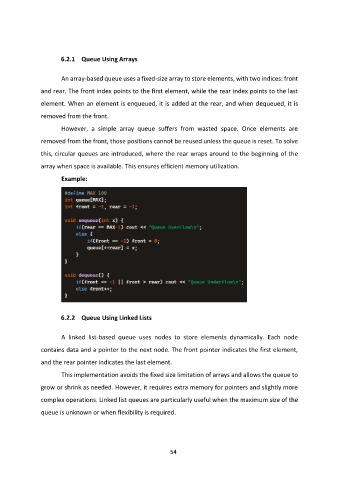
                       An array-based queue uses a fixed-size array to store elements, with two indices: front

               and rear. The front index points to the first element, while the rear index points to the last

               element. When an element is enqueued, it is added at the rear, and when dequeued, it is

               removed from the front.

                       However,  a  simple  array  queue  suffers  from  wasted  space.  Once  elements  are
               removed from the front, those positions cannot be reused unless the queue is reset. To solve

               this, circular queues are introduced, where the rear wraps around to the beginning of the

               array when space is available. This ensures efficient memory utilization.
                       Example:


                      6.2.2  Queue Using Linked Lists


                       A  linked  list-based  queue  uses  nodes  to  store  elements  dynamically.  Each  node

               contains data and a pointer to the next node. The front pointer indicates the first element,

               and the rear pointer indicates the last element.

                       This implementation avoids the fixed size limitation of arrays and allows the queue to
               grow or shrink as needed. However, it requires extra memory for pointers and slightly more

               complex operations. Linked list queues are particularly useful when the maximum size of the

               queue is unknown or when flexibility is required.


                                                             54

