


Page 88 - Data Structures Interactive Book
P. 88
are more space-efficient, can consume considerable memory when storing large networks
with billions of edges.
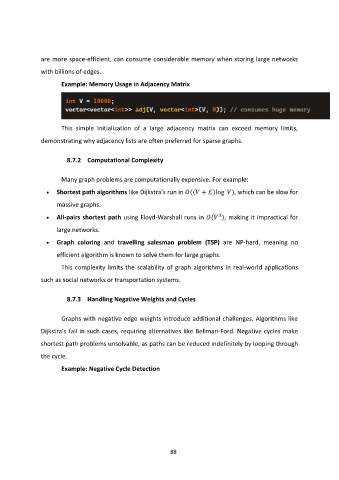
Example: Memory Usage in Adjacency Matrix
This simple initialization of a large adjacency matrix can exceed memory limits,
demonstrating why adjacency lists are often preferred for sparse graphs.
8.7.2 Computational Complexity
Many graph problems are computationally expensive. For example:
• Shortest path algorithms like Dijkstra’s run in (( + )log ), which can be slow for
massive graphs.
3
• All-pairs shortest path using Floyd-Warshall runs in ( ), making it impractical for
large networks.
• Graph coloring and travelling salesman problem (TSP) are NP-hard, meaning no
efficient algorithm is known to solve them for large graphs.
This complexity limits the scalability of graph algorithms in real-world applications
such as social networks or transportation systems.
8.7.3 Handling Negative Weights and Cycles
Graphs with negative edge weights introduce additional challenges. Algorithms like
Dijkstra’s fail in such cases, requiring alternatives like Bellman-Ford. Negative cycles make
shortest path problems unsolvable, as paths can be reduced indefinitely by looping through
the cycle.
Example: Negative Cycle Detection
88

