


Page 80 - Data Structures Handout_Neat
P. 80
8.4.2  Bellman-Ford Algorithm


                       The Bellman-Ford algorithm is designed to handle graphs with negative edge weights,

               something  Dijkstra’s  algorithm  cannot  manage. It  works  by  repeatedly  relaxing  all  edges,

               gradually improving the shortest path estimates. After    − 1iterations (where   is the number

               of vertices), the shortest paths are guaranteed to be found if no negative cycles exist. A final

               iteration checks for negative cycles: if any distance can still be improved, a negative cycle
               exists.

                       Step-by-step process:

                 1.  Initialize distances: source = 0, others = infinity.
                                                         ,
                 2.  Repeat    − 1times: for each edge (     ), update dist[v] if dist[u] + weight < dist[v].
                 3.  Check for negative cycles by performing one more relaxation.

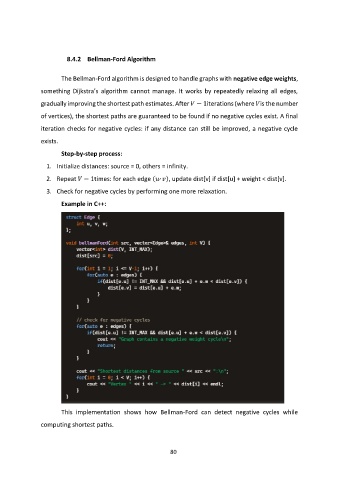
                       Example in C++:


                       This  implementation  shows  how  Bellman-Ford  can  detect  negative  cycles  while
               computing shortest paths.


                                                             80

