


Page 510 - PPL BEG-engelsk
P. 510
Principles of flight


               5.10.1.3     Density altitude


               The density altitude also has a lot to do with the take-off run.


               For example, if you are going to take off at 2000 ft., a higher speed is required

               before  the  lift  is  the  same  as  at  MSL,  because  the  distance  between  the
               molecules at that height is greater.


               In addition, the engine has lost some of its power in the thinner air.


               5.10.1.4    Performance tables


               Performance tables indicate take-off run (ground roll), which is the length of the

               runway used before an aircraft gets into the air.


               In addition, it also indicates how far the aircraft must travel in the horizontal
               plane, from the time the aircraft begins its take-off run until it passes 50 feet

               during the climb.


               We call this distance the take-off distance. These distances are often specified

               at different altitudes and in different wind conditions.


               Back to table of contents


               5.10.2    Climbing


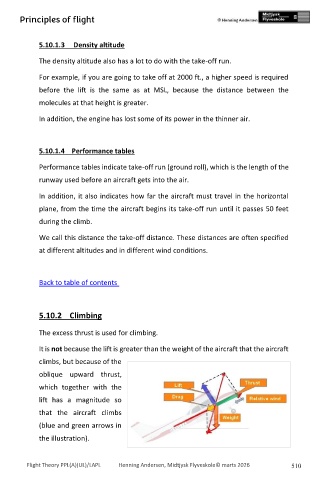
               The excess thrust is used for climbing.


               It is not because the lift is greater than the weight of the aircraft that the aircraft

               climbs, but because of the

               oblique  upward  thrust,

               which  together  with  the

               lift  has  a  magnitude  so
               that  the  aircraft  climbs

               (blue and green arrows in

               the illustration).


           Flight Theory PPL(A)(UL)/LAPL             Henning Andersen, Midtjysk Flyveskole© marts 2026     510

