


Page 40 - MAT KS3 Y8 Cambridge CheckPoint
P. 40
3.5 Dividing decimals


               3.5 Dividing decimals


               When you divide an integer or a decimal number by a single-digit number, it may not divide exactly.
               Then you will need to continue the division to a given number of decimal places. When you do this
               make sure that you work out the answer to one decimal place more than you are asked for, then round
               your answer to the appropriate degree of accuracy.


                Worked example 3.5
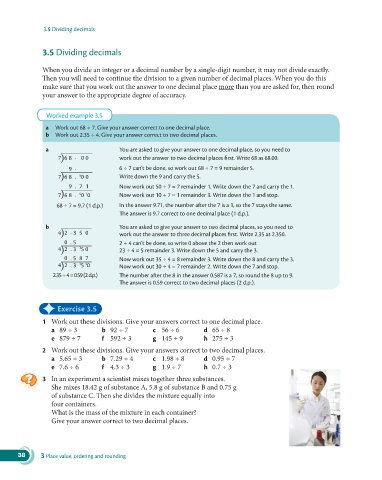
                a  Work out 68 ÷ 7. Give your answer correct to one decimal place.
                b  Work out 2.35 ÷ 4. Give your answer correct to two decimal places.

                a                          You are asked to give your answer to one decimal place, so you need to
                     )
                    76 8 . 00            work out the answer to two decimal places first. Write 68 as 68.00.
                        9 .              6 ÷ 7 can’t be done, so work out 68 ÷ 7 = 9 remainder 5.
                     )
                     76 8 . 00           Write down the 9 and carry the 5.
                           5
                        9.7 1            Now work out 50 ÷ 7 = 7 remainder 1. Write down the 7 and carry the 1.
                     )
                           5
                              1
                     76 8 . 0 0          Now work out 10 ÷ 7 = 1 remainder 3. Write down the 1 and stop.
                     68 ÷ 7 = 9.7 (1 d.p.)  In the answer 9.71, the number after the 7 is a 1, so the 7 stays the same.
                                         The answer is 9.7 correct to one decimal place (1 d.p.).

                b                          You are asked to give your answer to two decimal places, so you need to
                     )
                    42 . 350             work out the answer to three decimal places first. Write 2.35 as 2.350.
                       0. 5                2 ÷ 4 can’t be done, so write 0 above the 2 then work out
                     )
                           3
                    4 2. 3 50            23 ÷ 4 = 5 remainder 3. Write down the 5 and carry the 3.
                       0 . 587           Now work out 35 ÷ 4 = 8 remainder 3. Write down the 8 and carry the 3.
                      )    3  3          Now work out 30 ÷ 4 = 7 remainder 2. Write down the 7 and stop.
                    4 2. 3 5 0

                  2.35 ÷ 4 = 0.59 (2 d.p.)  The number after the 8 in the answer 0.587 is a 7, so round the 8 up to 9.
                                         The answer is 0.59 correct to two decimal places (2 d.p.).

               ✦     Exercise 3.5


               1  Work out these divisions. Give your answers correct to one decimal place.
                  a  89 ÷ 3        b 92 ÷ 7         c 56 ÷ 6         d 65 ÷ 8
                  e  879 ÷ 7       f 592 ÷ 3        g 145 ÷ 9        h 275 ÷ 3
               2  Work out these divisions. Give your answers correct to two decimal places.
                  a  5.65 ÷ 3      b 7.29 ÷ 4       c 1.98 ÷ 8       d 0.95 ÷ 7
                  e  7.6 ÷ 6       f 4.3 ÷ 3        g 1.9 ÷ 7        h 0.7 ÷ 3
               3  In an experiment a scientist mixes together three substances.
                    She mixes 18.42 g of substance A, 5.8 g of substance B and 0.75 g
                  of substance C. Then she divides the mixture equally into
                  four containers.
                  What is the mass of the mixture in each container?
                  Give your answer correct to two decimal places.


       38      3 Place value, ordering and rounding

