


Page 53 - MAT KS3 Y8 Cambridge CheckPoint
P. 53
5.1 Parallel lines


               5.1 Parallel lines


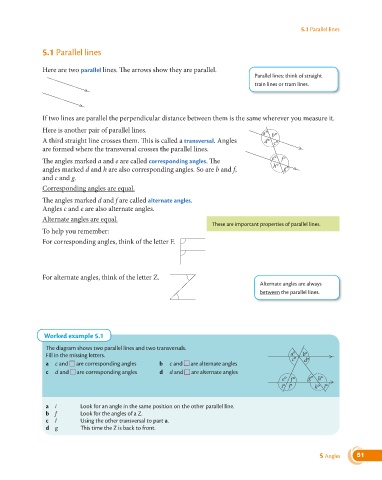
               Here are two parallel lines. The arrows show they are parallel.
                                                                                      Parallel lines: think of straight
                                                                                      train lines or tram lines.


               If two lines are parallel the perpendicular distance between them is the same wherever you measure it.
               Here is another pair of parallel lines.
                                                                                         a °
                                                                                            b °
               A third straight line crosses them. This is called a transversal. Angles   d °  c °
               are formed where the transversal crosses the parallel lines.

               The angles marked a and e are called corresponding angles. The               e ° f °
               angles marked d and h are also corresponding angles. So are b and f,         h °  g °
               and c and g.

               Corresponding angles are equal.
               The angles marked d and f are called alternate angles.
               Angles c and e are also alternate angles.
               Alternate angles are equal.
                                                                        These are important properties of parallel lines.
               To help you remember:
               For corresponding angles, think of the letter F.


               For alternate angles, think of the letter Z.
                                                                                        Alternate angles are always
                                                                                        between the parallel lines.


                Worked example 5.1

                The diagram shows two parallel lines and two transversals.
                Fill in the missing letters.                                                      a°  b°
                                                                                                  c°  d°
                a  c and   are corresponding angles   b  c and   are alternate angles
                c  d and   are corresponding angles   d  d and   are alternate angles
                                                                                               e° f °   g°  h°
                                                                                               i° j°      k° l°


                a  i        Look for an angle in the same position on the other parallel line.
                b  f        Look for the angles of a Z.
                c  l        Using the other transversal to part a.
                d  g        This time the Z is back to front.


                                                                                                            5 Angles    51

