


Page 136 - Cambridge Checkpoint Mathematics Coursebook 7_Slide 02
P. 136
13.3 Other straight lines


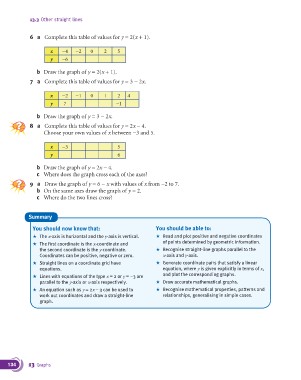
               6	 a  Complete this table of values for y = 2(x + 1).


                        x   −4    −2    0     2    5
                        y   −6

                  b	 Draw the graph of y = 2(x + 1).
               7	 a  Complete this table of values for y = 3 − 2x.


                        x   −2    −1    0     1    2   4
                        y    7                     −1

                  b	 Draw the graph of y = 3 − 2x.

               8	 a  Complete this table of values for y = 2x − 4.
                  	 Choose your own values of x between −3 and 5.


                        x   −3                     5
                        y                          6

                  b	 Draw the graph of y = 2x − 4.
                  c	 Where does the graph cross each of the axes?

               9	 a  Draw the graph of y = 6 − x with values of x from −2 to 7.
                  b	 On the same axes draw the graph of y = 2.
                  c	 Where do the two lines cross?


               Summary

                You should now know that:                          You should be able to:
                ★ ★ The x-axis is horizontal and the y-axis is vertical.  ★ ★ Read and plot positive and negative coordinates
                ★ ★ The first coordinate is the x-coordinate and      of points determined by geometric information.
                   the second coordinate is the y-coordinate.      ★ ★ Recognise straight-line graphs parallel to the
                   Coordinates can be positive, negative or zero.     x-axis and y-axis.
                ★ ★ Straight lines on a coordinate grid have       ★ ★ Generate coordinate pairs that satisfy a linear
                   equations.                                         equation, where y is given explicitly in terms of x,
                ★ ★ Lines with equations of the type x = 2 or y = –3 are   and plot the corresponding graphs.
                   parallel to the y-axis or x-axis respectively.  ★ ★ Draw accurate mathematical graphs.
                ★ ★ An equation such as y = 2x – 3 can be used to   ★ ★ Recognise mathematical properties, patterns and
                   work out coordinates and draw a straight-line      relationships, generalising in simple cases.
                   graph.
               *


      134      13 Graphs

