


Page 158 - Cambridge Checkpoint Mathematics Coursebook 7_Slide
P. 158
16.3 Mutually exclusive outcomes


               16.3 Mutually exclusive outcomes


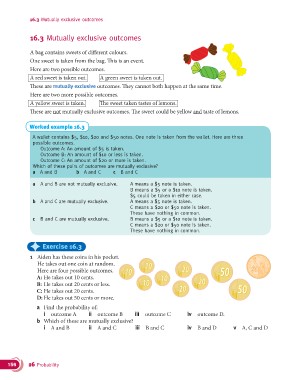
               A bag contains sweets of different colours.
               One sweet is taken from the bag. This is an event.
               Here are two possible outcomes.
               A red sweet is taken out.    A green sweet is taken out.
               These are mutually exclusive outcomes. They cannot both happen at the same time.
               Here are two more possible outcomes.
               A yellow sweet is taken.     The sweet taken tastes of lemons.

               These are not mutually exclusive outcomes. The sweet could be yellow and taste of lemons.


               Worked example 16.3

                A wallet contains $5, $10, $20 and $50 notes. One note is taken from the wallet. Here are three
                possible outcomes.
                   Outcome A: An amount of $5 is taken.
                   Outcome B: An amount of $10 or less is taken.
                   Outcome C: An amount of $20 or more is taken.
                Which of these pairs of outcomes are mutually exclusive?
                a  A and B        b  A and C     c  B and C


                a  A and B are not mutually exclusive.     A means a $5 note is taken.
                                                        B means a $5 or a $10 note is taken.
                                                        $5 could be taken in either case.
                b  A and C are mutually exclusive.        A means a $5 note is taken.
                                                        C means a $20 or $50 note is taken.
                                                        These have nothing in common.
                c  B and C are mutually exclusive.        B means a $5 or a $10 note is taken.
                                                        C means a $20 or $50 note is taken.
                                                        These have nothing in common.

               F     Exercise 16.3

               1  Aiden has these coins in his pocket.
                 He takes out one coin at random.              10 10
                 Here are four possible outcomes.     10 10                   20 20           50 50       $1
                  A: He takes out 10 cents.                          10 10           20 20
                  B: He takes out 20 cents or less.           10 10
                  C: He takes out 20 cents.                                  20 20                   50 50
                  D: He takes out 50 cents or more.
                  a  Find the probability of:
                    i  outcome A       ii  outcome B      iii  outcome C        iv  outcome D.
                  b  Which of these are mutually exclusive?
                    i  A and B         ii  A and C         iii  B and C         iv  B and D        v  A, C and D


      156      16 Probability

