


Page 119 - Cambridge Checkpoint Mathematics Coursebook 7_Slide 02
P. 119
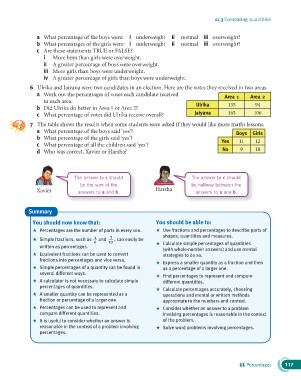
11.3 Comparing quantities


                  a	 What percentage of the boys were:  i underweight  ii normal  iii overweight?
                  b	 What percentages of the girls were:  i underweight  ii normal  iii overweight?
                  c	 Are these statements TRUE or FALSE?
                  	i     More boys than girls were overweight.
                  	 ii  A greater percentage of boys were overweight.
                  	 iii  More girls than boys were underweight.
                  	 iv  A greater percentage of girls than boys were underweight.

               6	  Ulrika and Jaiyana were two candidates in an election. Here are the votes they received in two areas.
                  a	 Work out the percentages of votes each candidate received                 Area	1     Area	2
                     in each area.
                  b	 Did Ulrika do better in Area 1 or Area 2?                      Ulrika       135        94
                  c	 What percentage of votes did Ulrika receive overall?          Jaiyana       165       106
               7	 The table shows the results when some students were asked if they would like more maths lessons.
                  a	 What percentage of the boys said ‘yes’?                                        Boys   Girls
                  b	 What percentage of the girls said ‘yes’?                                 Yes    11     12
                  c	 What percentage of all the children said ‘yes’?
                  d	 Who was correct, Xavier or Harsha?                                       No      9     18


                                 The answer to c should                           The answer to c should
                                    be the sum of the                             be halfway between the
                  	 Xavier         answers to a and b.             	 Harsha        answers to a and b.


               Summary

                You should now know that:                          You should be able to:

                ★   Percentages are the number of parts in every 100.  ★   Use fractions and percentages to describe parts of
                                                3
                                          1
                ★   Simple fractions, such as   and   10  , can easily be   shapes, quantities and measures.
                                          4
                   written as percentages.                         ★   Calculate simple percentages of quantities
                                                                      (with whole-number answers) and use mental
                ★   Equivalent fractions can be used to convert       strategies to do so.
                   fractions into percentages and vice versa.
                                                                   ★   Express a smaller quantity as a fraction and then
                ★   Simple percentages of a quantity can be found in   as a percentage of a larger one.
                   several different ways.
                                                                   ★   Find percentages to represent and compare
                ★   A calculator is not necessary to calculate simple   different quantities.
                   percentages of quantities.
                                                                   ★   Calculate percentages accurately, choosing
                ★   A smaller quantity can be represented as a        operations and mental or written methods
                   fraction or percentage of a larger one.            appropriate to the numbers and context.

                ★   Percentages can be used to represent and       ★   Consider whether an answer to a problem
                   compare different quantities.                      involving percentages is reasonable in the context
                ★   It is useful to consider whether an answer is     of the problem.
                   reasonable in the context of a problem involving   ★   Solve word problems involving percentages.
                   percentages.


                                                                                                     11 Percentages     117

