


Page 633 - Bob Holtzman "The Field Guide to Knots How to Identify.."
P. 633
Part Nine

               Whipping and Seizing


               There are many ways to prevent the end of a rope from unraveling (see
               Preventing Fraying), but whipping is by far the most effective. Whipping
               involves binding the rope’s strands or yarns with a tight wrapping of heavy
               thread or light twine. This seemingly imposing task is actually quite easy,

               and after doing it once or twice, you’ll find it second nature. Seizing is a
               similar procedure to permanently join two lengths of rope or sections of the
               same rope. A seized eye in the end of a rope is stronger, more secure, and
               more compact than any loop knot.


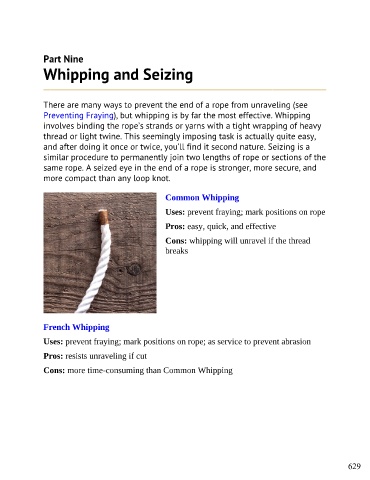
                                                        Common Whipping

                                                        Uses: prevent fraying; mark positions on rope

                                                        Pros: easy, quick, and effective

                                                        Cons: whipping will unravel if the thread
                                                        breaks


               French Whipping

               Uses: prevent fraying; mark positions on rope; as service to prevent abrasion

               Pros: resists unraveling if cut

               Cons: more time-consuming than Common Whipping


                                                                                                                    629

