


Page 24 - POSTER FYP MAC-OGOS 2025
P. 24
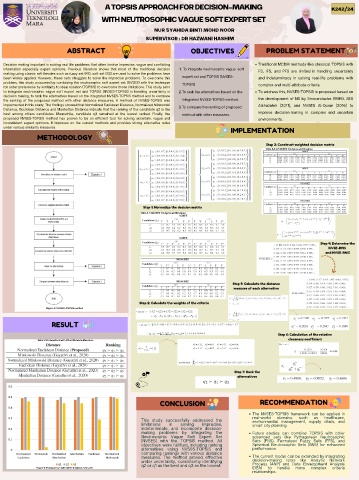
A TOPSIS APPROACH FOR DECISION-MAKING K242/24
WITH NEUTROSOPHIC VAGUE SOFT EXPERT SET
NUR SYAHIDA BINTI MOHD NOOR
SUPERVISOR : DR HAZWANI HASHIM
ABSTRACT OBJECTIVES PROBLEM STATEMENT
Decision making important in solving real life problems that often involve imprecise, vague and conflicting Traditional MCDM methods like classical TOPSIS with
information especially expert opinions. Previous literature shows that most of the traditional decision 1. To integrate neutrosophic vague soft FS, IFS, and PFS are limited in handling uncertainty
making using classic set theories such as fuzzy set (FS), soft set (SS) are used to solve the problems have
been widely applied. However, these sets struggles to solve the imprecise problems. To overcome this expert set and TOPSIS (NVSES- and indeterminacy in solving real-life problems with
problem, this study proposed by combining the neutrosophic soft expert set (NVSES) with the technique TOPSIS)
for order preference by similarity to ideal solution (TOPSIS) to overcome those limitations. This study aims complex and multi-attribute criteria.
to integrate neutrosophic vague soft expert set and TOPSIS (NVSES-TOPSIS) in handling uncertainty in 2.To rank the alternatives based on the To address this, NVSES-TOPSIS is proposed based on
decision making, to rank the alternatives based on the integrated NVSES-TOPSIS method and to compare
the ranking of the proposed method with other distance measures. A method of NVSES-TOPSIS was integrated NVSES-TOPSIS method. the development of NS by Smarandache (1999), SES
implemented in this study. The findings showed that Normalized Euclidean Distance, Normalized Minkowski 3.To compare the ranking of proposed Alkhazaleh (2011), and NVSES Al-Quran (2016) to
Distance, Euclidean Distance and Manhattan Distance indicate that the ranking of the candidate q2 is the
best among others candidates. Meanwhile, candidate q3 remained at the lowest ranked. Finally, the method with other measures. improve decision-making in complex and uncertain
proposed NVSES-TOPSIS method has proven to be an efficient tool for solving uncertain, vague and environments.
inconsistent expert opinions. It improves on the current methods and provides strong alternative ranks
under various similarity measures.
IMPLEMENTATION
METHODOLOGY
Step 3: Construct weighted decision matrix
Table 4.2: A* NVSES for Agree and Disagree
Step 1: Normalize the decision matrix
Table 4.1: ANVSES for Agree and Disagree
Step 4: Determine the
NVSE-RPIS
and NVSE-RNIS
Step 5: Calculate the distance
measure of each alternative
Step 2: Calculate the weights of the criteria
Figure 3.1 NVSES-TOPSIS method
RESULT
Step 6: Calculation of the relative
Table 5.1 Comparison with Other Distance Measures closeness coefficient
Step 7: Rank the
alternatives
CONCLUSION RECOMMENDATION
The NVSES-TOPSIS framework can be applied in
real-world domains such as healthcare,
This study successfully addressed the environmental management, supply chain, and
limitations in solving imprecise, smart city planning.
indeterminate, and incomplete decision-
making problems by integrating the Future studies can combine TOPSIS with other
Neutrosophic Vague Soft Expert Set advanced sets like Pythagorean Neutrosophic
(NVSES) with the TOPSIS method. All Sets (PNS), Fermatean Fuzzy Sets (FFS), and
objectives were fulfilled, including ranking Spherical Neutrosophic Sets (SNS) for enhanced
alternatives using NVSES-TOPSIS and performance.
comparing rankings with various distance
measures. The method proved effective The current model can be extended by integrating
under uncertainty, consistently identifying decision-making tools like Analytic Network
q2 or q1 as the best and q3 as the lowest. Process (ANP) and Data Envelopment Analysis
Figure 5.1 Comparison with other distance measures (DEA) to handle more complex criteria
relationships.

