Page 41 - moondani kyema
P. 41
moondani kyema, My Story - Ray Moore 41
A couple of times Red
Cross parcels were
distributed, and the
main item of interest to
me was the powdered
milk. It was only a
tablespoonful, but I
loved the beautiful taste
of that powder mixed
with a little water and
eaten a lick at a time
from the spoon. There
were also times when
there were actually
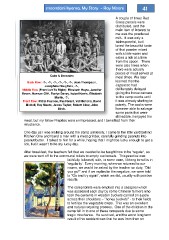
Cubs & Brownies pieces of meat served at
meal times. We later
Back Row: -?-, -?-, -?-, -?-, -?-, -?-, Joan Thompson, learned that the
Josephine Houghton, -?-, Japanese had
deliberately delayed
Middle Row (From Left To Right): Elizabeth Hoyte, Jennifer giving the horse carcass
Beven, Norman Cliff, Evelyn Davey, Isabel Harris, Elizabeth to the camp cooks until
Martin, -?-,
Front Row: Philip Paulson, Paul Grant, Val Nicholls, David it was already starting to
Michell, Ray Moore, James Taylor, Robert Clow, John putrefy. The cooks were
Birch. however able to salvage
some parts that were
still edible. I enjoyed the
meat, but my fellow Prepites were unimpressed, and I benefited from their
reluctance.
One day as I was walking around the camp aimlessly, I came to the little yard behind
Kitchen One and found a man with a meat grinder, carefully grinding peanuts into
peanut butter. I talked to him for a while, hoping that I might be lucky enough to get a
lick, but it wasn’t to be my lucky day.
After breakfast, the teachers felt that we needed to be taught how to be 'regular', so
we were sent off to the communal toilets to empty our bowels. This practice was
faithfully followed, with, in some case, lifelong benefits in
'regularity'. Every morning, when we returned to our
rooms, we would be asked by the teacher on duty, “Did
you go?” and if we replied in the negative, we were told
to “Go and try again”, which we did, usually with positive
results.
The camp toilets were emptied into a cesspool which
was accessed each day by some Chinese farmers who
took the contents in wooden buckets carried on a pole
across their shoulders – “honey buckets” - to their fields
to fertilize the vegetable crops. This was an excellent
and natural recycling process. One of the children in the
camp fell in to one of these cesspools due to some
tragic mischance. He survived, and the worst long term
result of his accident was that he was from then on
A couple of times Red
Cross parcels were
distributed, and the
main item of interest to
me was the powdered
milk. It was only a
tablespoonful, but I
loved the beautiful taste
of that powder mixed
with a little water and
eaten a lick at a time
from the spoon. There
were also times when
there were actually
Cubs & Brownies pieces of meat served at
meal times. We later
Back Row: -?-, -?-, -?-, -?-, -?-, -?-, Joan Thompson, learned that the
Josephine Houghton, -?-, Japanese had
deliberately delayed
Middle Row (From Left To Right): Elizabeth Hoyte, Jennifer giving the horse carcass
Beven, Norman Cliff, Evelyn Davey, Isabel Harris, Elizabeth to the camp cooks until
Martin, -?-,
Front Row: Philip Paulson, Paul Grant, Val Nicholls, David it was already starting to
Michell, Ray Moore, James Taylor, Robert Clow, John putrefy. The cooks were
Birch. however able to salvage
some parts that were
still edible. I enjoyed the
meat, but my fellow Prepites were unimpressed, and I benefited from their
reluctance.
One day as I was walking around the camp aimlessly, I came to the little yard behind
Kitchen One and found a man with a meat grinder, carefully grinding peanuts into
peanut butter. I talked to him for a while, hoping that I might be lucky enough to get a
lick, but it wasn’t to be my lucky day.
After breakfast, the teachers felt that we needed to be taught how to be 'regular', so
we were sent off to the communal toilets to empty our bowels. This practice was
faithfully followed, with, in some case, lifelong benefits in
'regularity'. Every morning, when we returned to our
rooms, we would be asked by the teacher on duty, “Did
you go?” and if we replied in the negative, we were told
to “Go and try again”, which we did, usually with positive
results.
The camp toilets were emptied into a cesspool which
was accessed each day by some Chinese farmers who
took the contents in wooden buckets carried on a pole
across their shoulders – “honey buckets” - to their fields
to fertilize the vegetable crops. This was an excellent
and natural recycling process. One of the children in the
camp fell in to one of these cesspools due to some
tragic mischance. He survived, and the worst long term
result of his accident was that he was from then on