Page 8 - moondani kyema
P. 8
ndani kyema, My Story - Ray Moore 8
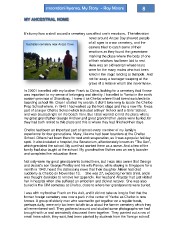
It’s funny how a stroll around a cemetery can affect one’s emotions. The television
news around Anzac Day showed people
Australian cemetery near Anzac Cove. of all ages in a war cemetery, and the
camera tried to catch some of their
emotions as they found the gravestone
marking the place where the body of one
of their relatives had been laid to rest.
Here was an old veteran whose tears
were for the many mates who had been
killed in the tragic landing at Gallipoli. And
not far away a teenager weeping at the
grave of a relative whom she never knew.
In 2000 I travelled with my brother Frank to China, looking for a cemetery that I knew
was important to my sense of belonging and identity. I travelled to Yantai in the north
eastern province of Shandong. I knew it as Chefoo where I had been launched into
boarding school life. Once I started my search, it didn’t take long to locate the Chefoo
Prep School where, in 1940 I had walked up the front steps and into a new life. It was
part of a larger Chefoo School which included a Boys’ School and a Girls’ School,
and was situated right on the beach front. But I also wanted to find the place where
my great grandfather George Andrew and great grandmother Jessie were buried, for
they had both retired to this place and this is where they had finished their days.
Chefoo had been an important part of almost every member of my family’s
experience for four generations. Many, like me had been boarders at the Chefoo
School. Others had been there for rest and recuperation, as it was a popular holiday
spot. It also included a hospital, the Sanatorium, affectionately known as “The San”,
which predated the school. My aunt had worked there as a nurse. And a few of the
family had also taught at the school. My grandmother Esther was an early boarder
and completed her education there.
Not only were my great grandparents buried there, but I was also aware that George
and Jessie’s son George Findlay and his wife Fanny, while staying in Singapore for a
month in 1940, heard the distressing news that their daughter Aileen had died
suddenly at Chefoo on November 13. She was 27, expecting her first child, and it
was thought desirable to remove her appendix. Her husband Allastair had just visited
her in hospital when she suffered an embolism and did not recover. She was also
buried in the CIM cemetery at Chefoo, close to where her grandparents were buried.
I was with my brother Frank on this visit, and it did not take us long to find that the
former foreign cemetery was now a park in the center of Yantai as Chefoo is now
known. A group of elderly men who seemed to get together on a regular basis,
perhaps daily, were only too keen to talk to us about the former cemetery which they
all remembered well. They gathered around and studied some photographs we had
brought with us and animatedly discussed them together. They pointed out a row of
small trees which, they said, had been planted by students from the ‘foreign school’.
It’s funny how a stroll around a cemetery can affect one’s emotions. The television
news around Anzac Day showed people
Australian cemetery near Anzac Cove. of all ages in a war cemetery, and the
camera tried to catch some of their
emotions as they found the gravestone
marking the place where the body of one
of their relatives had been laid to rest.
Here was an old veteran whose tears
were for the many mates who had been
killed in the tragic landing at Gallipoli. And
not far away a teenager weeping at the
grave of a relative whom she never knew.
In 2000 I travelled with my brother Frank to China, looking for a cemetery that I knew
was important to my sense of belonging and identity. I travelled to Yantai in the north
eastern province of Shandong. I knew it as Chefoo where I had been launched into
boarding school life. Once I started my search, it didn’t take long to locate the Chefoo
Prep School where, in 1940 I had walked up the front steps and into a new life. It was
part of a larger Chefoo School which included a Boys’ School and a Girls’ School,
and was situated right on the beach front. But I also wanted to find the place where
my great grandfather George Andrew and great grandmother Jessie were buried, for
they had both retired to this place and this is where they had finished their days.
Chefoo had been an important part of almost every member of my family’s
experience for four generations. Many, like me had been boarders at the Chefoo
School. Others had been there for rest and recuperation, as it was a popular holiday
spot. It also included a hospital, the Sanatorium, affectionately known as “The San”,
which predated the school. My aunt had worked there as a nurse. And a few of the
family had also taught at the school. My grandmother Esther was an early boarder
and completed her education there.
Not only were my great grandparents buried there, but I was also aware that George
and Jessie’s son George Findlay and his wife Fanny, while staying in Singapore for a
month in 1940, heard the distressing news that their daughter Aileen had died
suddenly at Chefoo on November 13. She was 27, expecting her first child, and it
was thought desirable to remove her appendix. Her husband Allastair had just visited
her in hospital when she suffered an embolism and did not recover. She was also
buried in the CIM cemetery at Chefoo, close to where her grandparents were buried.
I was with my brother Frank on this visit, and it did not take us long to find that the
former foreign cemetery was now a park in the center of Yantai as Chefoo is now
known. A group of elderly men who seemed to get together on a regular basis,
perhaps daily, were only too keen to talk to us about the former cemetery which they
all remembered well. They gathered around and studied some photographs we had
brought with us and animatedly discussed them together. They pointed out a row of
small trees which, they said, had been planted by students from the ‘foreign school’.