Page 50 - goDesana Stillroom Recipes For Kids & Elderly - Michelle Fitch
P. 50
West Nile Virus Facts
West Nile Virus is normally found in temperate and tropical regions of the world. It was frst
identifed in the West Nile subregion of the East African nation of Uganda in 1937. Prior to
the mid-1990s, WNV disease occurred only sporadically and was considered a minor risk for
humans, until an outbreak in Algeria in 1994, with cases of WNV-caused encephalitis, and
the frst large outbreak in Romania in 1996, with a high number of cases with neuroinvasive
disease. WNV has now spread globally, with the frst case in the Western Hemisphere being
identifed in New York City in 1999. 2
Mosquitoes carry the highest amounts of virus in the early fall, which is why the rate of the
disease increases in late August to early September. The risk of disease decreases as the
weather becomes colder and mosquitoes die off. West Nile Virus is an infectious disease
transmitted to people by the bite of an infected mosquito that picked it up from an infected
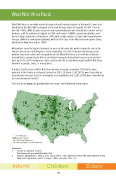
bird. By 2013, all 48 contiguous states and the District of Columbia reported West Nile Virus
infection in people, birds, or mosquitoes.
A total of 2,469 cases of West Nile Virus disease in people, including 119 deaths, were
reported to the Center for Disease Control for 2013. Of these 1,267 (51%) were classifed as
neuroinvasive disease (such as meningitis or encephalitis) and 1,202 (49%) were classifed as
non-neuroinvasive disease. 1
You can go to www.cdc.gov/westnile for maps and additional information.
References
1 Center for Disease Control
http://www.cdc.gov/westnile/index.html
2 Nash D, Mostashari F, Fine A, et al. (June 2001). “The outbreak of West Nile virus infection in the
New York City area in 1999”. N. Engl. J. Med. 344 (24): 1807–14.
Infants Children Elderly
46