


Page 157 - A Walk to Caesarea / Joseph Patrich
P. 157
A Walk to Caesarea: A Historical-Archaeological Perspective 143
ab

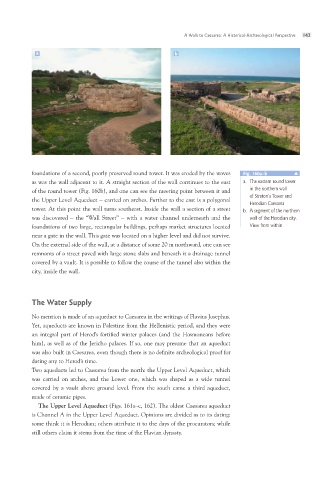
foundations of a second, poorly preserved round tower. It was eroded by the waves      Fig. 160a–b
as was the wall adjacent to it. A straight section of the wall continues to the east
of the round tower (Fig. 160b), and one can see the meeting point between it and       a.	 The eastern round tower
the Upper Level Aqueduct – carried on arches. Further to the east is a polygonal          in the northern wall
tower. At this point the wall turns southeast. Inside the wall a section of a street      of Straton’s Tower and
was discovered – the “Wall Street” – with a water channel underneath and the              Herodian Caesarea
foundations of two large, rectangular buildings, perhaps market structures located
near a gate in the wall. This gate was located on a higher level and did not survive.  b.	 A segment of the northern
On the external side of the wall, at a distance of some 20 m northward, one can see       wall of the Herodian city.
remnants of a street paved with large stone slabs and beneath it a drainage tunnel        View from within
covered by a vault. It is possible to follow the course of the tunnel also within the
city, inside the wall.

The Water Supply

No mention is made of an aqueduct to Caesarea in the writings of Flavius Josephus.
Yet, aqueducts are known in Palestine from the Hellenistic period, and they were
an integral part of Herod’s fortified winter palaces (and the Hasmoneans before
him), as well as of the Jericho palaces. If so, one may presume that an aqueduct
was also built in Caesarea, even though there is no definite archeological proof for
dating any to Herod’s time.
Two aqueducts led to Caesarea from the north: the Upper Level Aqueduct, which
was carried on arches, and the Lower one, which was shaped as a wide tunnel
covered by a vault above ground level. From the south came a third aqueduct,
made of ceramic pipes.

   The Upper Level Aqueduct (Figs. 161a–c, 162). The oldest Caesarea aqueduct
is Channel A in the Upper Level Aqueduct. Opinions are divided as to its dating:
some think it is Herodian; others attribute it to the days of the procurators; while
still others claim it stems from the time of the Flavian dynasty.

