


Page 165 - A Walk to Caesarea / Joseph Patrich
P. 165
A Walk to Caesarea: A Historical-Archaeological Perspective 151

thick marble sides and it was plastered on its interior side. Two counting devices

for the laps, by using 7 “eggs” and 7 dolphins were added at the Circus Maximus

by Agrippa, Augustus’ senior aide, adjacent to the turning posts. The finish line –

about halfway between the two turning posts (metae) and on the right hand side

of the arena – was also marked with white lime. The judges’ box (tribunal) as well

was located on this side. Facing it, on the left side of the arena, were the seats of

the dignitaries (pulvinar), and in the middle, in the line of the spina – an obelisk.

Such a granite obelisk was found fallen in the Caesarea arena, broken into three

parts. In September 2004, the fragments were united                     a
and the obelisk was set up anew a bit to the east of

the spina line by the preservation staff of the IAA

(Fig. 170a–b).

The Necropolis                                                          b
                                                                        c
“East of Qisri(n) … are graveyards” (Mishnah Oholot
18:10 [9]). This testimony refers to the area to the east
of the Herodian city wall, a section in which as yet
there have been no large-scale excavations. With the
spread of the city, from the second century on, a new,
larger cemetery evolved at the edges of the expanded
city, in areas now outside the Byzantine city wall. Many
graves, of various types – burial caves with chambers,
pit graves, and cist graves as well as sarcophagi, were
discovered beyond the Byzantine wall. They relate to
all the religious groups that lived in the city – Jews,
pagans, Christians, and Samaritans – as one may learn
from the text of the many burial inscriptions; those of
Jews can sometimes be recognized by their content,
the names of the interred, and menorah decorations,
though at times it is difficult to decide between Jews

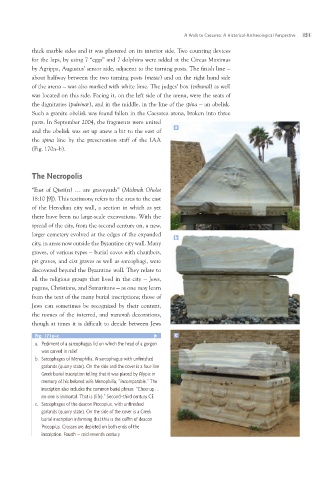
 Fig. 171a–c
 a.	 Pediment of a sarcophagus lid on which the head of a gorgon

     was carved in relief
 b.	 Sarcophagus of Menophilia. A sarcophagus with unfinished

     garlands (quarry state). On the side and the cover is a four-line
     Greek burial inscription telling that it was placed by Alypis in
     memory of his beloved wife Menophilia, “incomparable.” The
     inscription also includes the common burial phrase: “Cheer up …
     no one is immortal. That is (life).” Second–third century CE
 c.	 Sarcophagus of the deacon Procopius, with unfinished
     garlands (quarry state). On the side of the cover is a Greek
     burial inscription informing that this is the coffin of deacon
     Procopius. Crosses are depicted on both ends of the
     inscription. Fourth – mid-seventh century

