


Page 190 - A Walk to Caesarea / Joseph Patrich
P. 190
Caesarea, the capital of the province of Judaea-Palaestina in the Roman and Byzantine periods, is one of Israel's
most important archaeological attractions, providing a glimpse at centuries of history.
This book is the product of extensive excavations conducted in Caesarea from the early 1990s by archaeological
expeditions from Israel and abroad. The structures and small finds uncovered in these and earlier excavations,
and works of restoration and development that followed them, transformed ancient Caesarea into a world-class
tourist attraction. An analysis of all of the findings on the basis of a variety of historical sources and the many
inscriptions from the site, makes it possible to revise the history of Caesarea in detail and to provide the visitor
to the historical city a comprehensive guide.
The book consists of two parts: a historical review and an archaeological guide. The historical review starts with
Straton's tower – the Hellenistic site that preceded Caesarea – and concludes with the founding of Kibbutz
Sdot Yam in 1940. It covers the Herodian period, the Roman and Byzantine periods when Caesarea reached its
greatest development and territorial extension, and the early Muslim and Crusader periods, when the city was
much reduced in size. In the late Muslim period Caesarea was just a pile of rubble, and in the 19th-century the
Ottoman authorities settled Bosnian refugees among the ruins.
The archaeological review presents a number of walking tours: an internal route along the Mediterranean coast,
from the Roman theater in the south to the aqueduct in the north and a peripheral route related to the ruins east
of the Crusader wall and adjacent to the Roman-Byzantine wall. Also are included a tour along the aqueducts of
Caesarea and a visit to the Archaeological Museum in Kibbutz Sdot Yam and to the archaeological exhibition in
Ralli 1 Museum in modern Caesarea.
Numerous illustrations are included in the book – photographs, maps, plans and graphical reconstructions. The
reader will also find a glossary, chronological table and a selected bibliography for further reading.
Joseph Patrich, professor of archaeology at the Hebrew University of Jerusalem, directed the excavations at Caesarea
in 1993–1998 and 2000–2001 that uncovered the Byzantine governor's palace, the complex of warehouses with
the adjacent streets and the starting gates of the hippo-stadium. Prof. Patrich is a leading authority on Caesarea.
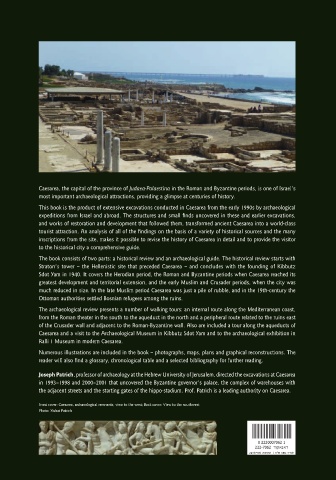
Front cover: Caesarea, archaeological remnants, view to the west; Back cover: View to the southwest
Photo: Yishai Patrich
2018 מאי: ש"ח | הדפסה140 :מחיר

