


Page 16 - ASME DSCC 2018 Program
P. 16
Plenary Sessions

    “HOW CONTROL THEORIES WERE USED TO IMPROVE ENEREGY AND                         “TOWARDS ROBOTS THAT TEACH AND LEARN THROUGH PHYSICAL
    SAFETY OF AUTOMOTIVE SYSTEMS”                                                  HUMAN-ROBOT INTERACTION”
    MONDAY, OCTOBER 1                                                              TUESDAY, OCTOBER 2
    8:30AM – 9:30AM                                                                8:30AM – 9:30AM
    INTERNATIONAL BALLROOM NORTH (LOWER LEVEL 1)                                   INTERNATIONAL BALLROOM NORTH (LOWER LEVEL 1)

    Session Chair: Anna Stefanopoulou, University of Michigan                      Session Chair: George Zhu, Michigan State University

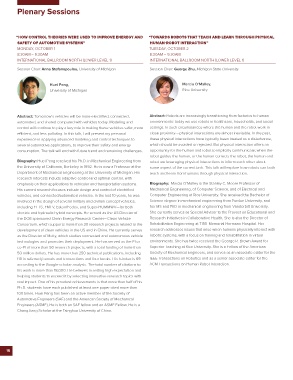
    Huei Peng,                                                                     Marcia O’Malley,
    University of Michigan                                                         Rice University

    Abstract: Tomorrow’s vehicles will be more electrified, connected,             Abstract: Robots are increasingly transitioning from factories to human
    automated, and shared compared with vehicles today. Modeling and               environments: today we use robots in healthcare, households, and social
    control will continue to play a key role in making these vehicles safer, more  settings. In such circumstances where the human and the robot work in
    efficient, and less polluting. In this talk, I will present my personal        close proximity---physical interactions are almost inevitable. In the past,
    experience in applying advanced modeling and control techniques to             these physical interactions have typically been treated as a disturbance,
    several automotive applications, to improve their safety and energy            which should be avoided or rejected. But physical interaction offers an
    consumption. The talk will end with future trend and remaining challenges.     opportunity for the human and robot to implicitly communicate; when the
                                                                                   robot guides the human, or the human corrects the robot, the human and
    Biography: Huei Peng received his Ph.D. in Mechanical Engineering from         robot are leveraging physical interactions to inform each other about
    the University of California, Berkeley in 1992. He is now a Professor at the   some aspect of the current task. This talk will explore how robots can both
    Department of Mechanical Engineering at the University of Michigan. His        teach and learn from humans through physical interaction.
    research interests include adaptive control and optimal control, with
    emphasis on their applications to vehicular and transportation systems.        Biography: Marcia O’Malley is the Stanley C. Moore Professor of
    His current research focuses include design and control of electrified         Mechanical Engineering, of Computer Science, and of Electrical and
    vehicles, and connected/automated vehicles. In the last 10 years, he was       Computer Engineering at Rice University. She received the Bachelor of
    involved in the design of several military and civilian concept vehicles,      Science degree in mechanical engineering from Purdue University, and
    including FTTS, FMTV, Eaton/Fedex, and Super-HUMMWV—for both                   her MS and PhD in mechanical engineering from Vanderbilt University.
    electric and hydraulic hybrid concepts. He served as the US Director of        She currently serves as Special Advisor to the Provost on Educational and
    the DOE sponsored Clean Energy Research Center—Clean Vehicle                   Research Initiatives in Collaborative Health. She is also the Director of
    Consortium, which supports more than 30 research projects related to the       Rehabilitation Engineering at TIRR-Memorial Hermann Hospital. Her
    development of clean vehicles in the US and in China. He currently serves      research addresses issues that arise when humans physically interact with
    as the Director of Mcity, which studies connected and autonomous vehicle       robotic systems, with a focus on training and rehabilitation in virtual
    technologies and promotes their deployment. He has served as the PI or         environments. She has twice received the George R. Brown Award for
    co-PI of more than 50 research projects, with a total funding of more than     Superior Teaching at Rice University. She is a Fellow of the American
    50 million dollars. He has more than 250 technical publications, including     Society of Mechanical Engineers, and serves as an associate editor for the
    110 in referred journals and transactions and four books. His h-index is 69    IEEE Transactions on Robotics and as a senior associate editor for the
    according to the Google scholar analysis. The total number of citations to     ACM Transactions on Human Robot Interaction.
    his work is more than 18,000. He believes in setting high expectation and
    helping students to exceed it by selecting innovative research topics with
    real impact. One of his proudest achievements is that more than half of his
    Ph.D. students have each published at least one paper cited more than
    100 times. Huei Peng has been an active member of the Society of
    Automotive Engineers (SAE) and the American Society of Mechanical
    Engineers (ASME). He is both an SAE fellow and an ASME Fellow. He is a
    ChangJiang Scholar at the Tsinghua University of China.

16

