


Page 130 - American Stories, A History of the United States
P. 130
Although France and Britain had not officially declared war, British officials
                    advised the governor of Virginia to “repell force by force.” The Virginians needed lit-                4.1
                    tle encouragement. They were eager to make good their claim to the Ohio Valley. In
                    1754, militia companies under a promising young officer, George Washington, con-
                    structed Fort Necessity not far from Fort Duquesne. The plan failed. The French and                    4.2
                    their Indian allies overran the exposed outpost (July 3, 1754). The humiliating setback
                    revealed that a single colony could not defeat the French.
                       Benjamin Franklin, for one, appreciated the need for intercolonial cooperation.                     4.3
                    When British officials invited representatives from Virginia, Maryland, and the north-
                    ern colonies to Albany (June 1754) to discuss relations with the Iroquois, Franklin used
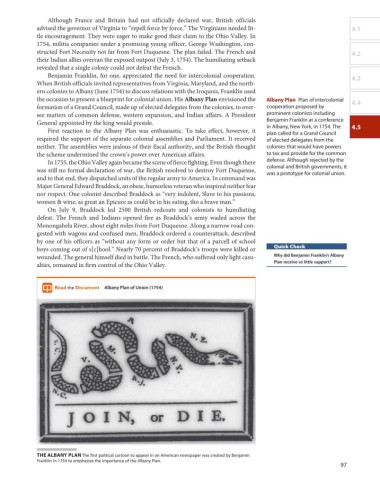
                    the occasion to present a blueprint for colonial union. His Albany Plan envisioned the   albany plan  Plan of intercolonial   4.4
                    formation of a Grand Council, made up of elected delegates from the colonies, to over-  cooperation proposed by
                    see matters of common defense, western expansion, and Indian affairs. A President   prominent colonists including
                    General appointed by the king would preside.                               benjamin Franklin at a conference
                                                                                               in Albany, New york, in 1754. the
                       First reaction to the Albany Plan was enthusiastic. To take effect, however, it   plan called for a Grand council   4.5
                    required the support of the separate colonial assemblies and Parliament. It received   of elected delegates from the
                    neither. The assemblies were jealous of their fiscal authority, and the British thought   colonies that would have powers
                    the scheme undermined the crown’s power over American affairs.             to tax and provide for the common
                       In 1755, the Ohio Valley again became the scene of fierce fighting. Even though there   defense. Although rejected by the
                    was still no formal declaration of war, the British resolved to destroy Fort Duquesne,   colonial and british governments, it
                                                                                               was a prototype for colonial union.
                    and to that end, they dispatched units of the regular army to America. In command was
                    Major General Edward Braddock, an obese, humorless veteran who inspired neither fear
                    nor respect. One colonist described Braddock as “very indolent, Slave to his passions,
                    women & wine, as great an Epicure as could be in his eating, tho a brave man.”
                       On July 9, Braddock led 2500 British redcoats and colonists to humiliating
                    defeat.  The  French  and  Indians  opened  fire  as  Braddock’s  army  waded  across  the
                      Monongahela River, about eight miles from Fort Duquesne. Along a narrow road con-
                    gested with  wagons and confused men, Braddock ordered a counterattack, described
                    by one of his officers as “without any form or order but that of a parcell of school
                    boys coming out of s[c]hool.” Nearly 70 percent of Braddock’s troops were killed or   Quick Check
                    wounded. The general himself died in battle. The French, who suffered only light casu-  Why did Benjamin Franklin’s Albany
                    alties, remained in firm control of the Ohio Valley.                          Plan receive so little support?


                           Read the Document  Albany Plan of Union (1754)


                    THE alBaNy plaN the first political cartoon to appear in an American newspaper was created by benjamin
                    Franklin in 1754 to emphasize the importance of the Albany Plan.
                                                                                                                        97

