


Page 574 - Business Principles and Management
P. 574
Chapter 21 • Product Development and Distribution


                        pocket- or desk-sized and be capable of special
                        mathematical functions. Also, it might come in a
                        variety of colors and include a protective case and
                        an instruction manual. Given the combination of
                        features, the price of the calculator could range
                        from a few dollars to as much as $50 or more. If
                        you were the person responsible for designing a
                        calculator to sell, what combination of design fea-
                        tures would you include? This example shows that
                        product planning can be very complex. Businesses
                        have many choices in designing products. In devel-
                        oping their product strategy, marketers pay close
                        attention to their customers’ needs and wishes.  PHOTO: © GETTY IMAGES/PHOTODISC.


                        PRODUCT DESIGN LEVELS
                        There are three levels of product design—a basic
                        product, an enhanced product, and an extended
                        product. The basic product is the physical product
                        in its simplest form. It should be easy for consumers
                        to understand and see how it can meet a need. The
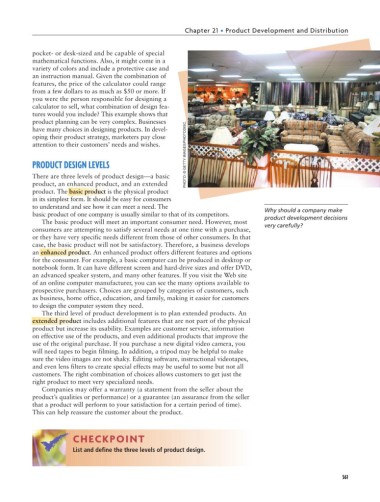
                        basic product of one company is usually similar to that of its competitors.  Why should a company make
                                                                                                 product development decisions
                           The basic product will meet an important consumer need. However, most
                        consumers are attempting to satisfy several needs at one time with a purchase,  very carefully?
                        or they have very specific needs different from those of other consumers. In that
                        case, the basic product will not be satisfactory. Therefore, a business develops
                        an enhanced product. An enhanced product offers different features and options
                        for the consumer. For example, a basic computer can be produced in desktop or
                        notebook form. It can have different screen and hard-drive sizes and offer DVD,
                        an advanced speaker system, and many other features. If you visit the Web site
                        of an online computer manufacturer, you can see the many options available to
                        prospective purchasers. Choices are grouped by categories of customers, such
                        as business, home office, education, and family, making it easier for customers
                        to design the computer system they need.
                           The third level of product development is to plan extended products. An
                        extended product includes additional features that are not part of the physical
                        product but increase its usability. Examples are customer service, information
                        on effective use of the products, and even additional products that improve the
                        use of the original purchase. If you purchase a new digital video camera, you
                        will need tapes to begin filming. In addition, a tripod may be helpful to make
                        sure the video images are not shaky. Editing software, instructional videotapes,
                        and even lens filters to create special effects may be useful to some but not all
                        customers. The right combination of choices allows customers to get just the
                        right product to meet very specialized needs.
                           Companies may offer a warranty (a statement from the seller about the
                        product’s qualities or performance) or a guarantee (an assurance from the seller
                        that a product will perform to your satisfaction for a certain period of time).
                        This can help reassure the customer about the product.


                                     CHECKPOINT
                                     List and define the three levels of product design.


                                                                                                                          561

