


Page 581 - Business Principles and Management
P. 581
Unit 6


                                                                part of sales for many companies because of the speed and
                                                                efficiency of this distribution method.


                                                                INDIRECT DISTRIBUTION
                                                                When producers cannot or choose not to perform all market-
                                                                ing activities, they need an indirect channel of distribution.
                                                                Manufacturers can simplify many of their marketing opera-
                                                             PHOTO: © DIGITAL VISION.  because they sell to a small number of retail customers rather
                                                                tions by selling to retailers. They will need fewer salespeople,
                                                                than to a very large number of final consumers. They can
                                                                share advertising with the retailers, and the retailers will be
                                                                responsible for much of the product storage, consumer credit
                                                                management, and other activities. Retailers specialize in mar-
                                                                keting activities, and this allows producers to specialize in
                                                                manufacturing activities. As you learned in Chapter 1, spe-
                                                                cialization leads to improved efficiency, which benefits con-
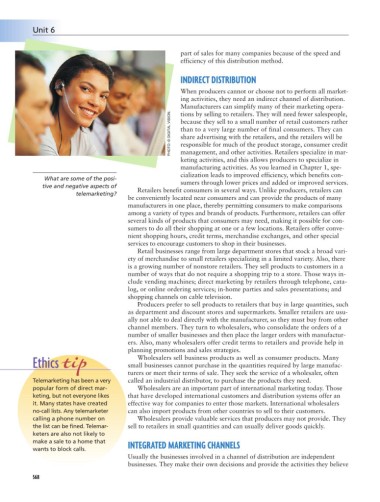
                     What are some of the posi-                 sumers through lower prices and added or improved services.
                     tive and negative aspects of
                                                   Retailers benefit consumers in several ways. Unlike producers, retailers can
                               telemarketing?
                                                be conveniently located near consumers and can provide the products of many
                                                manufacturers in one place, thereby permitting consumers to make comparisons
                                                among a variety of types and brands of products. Furthermore, retailers can offer
                                                several kinds of products that consumers may need, making it possible for con-
                                                sumers to do all their shopping at one or a few locations. Retailers offer conve-
                                                nient shopping hours, credit terms, merchandise exchanges, and other special
                                                services to encourage customers to shop in their businesses.
                                                   Retail businesses range from large department stores that stock a broad vari-
                                                ety of merchandise to small retailers specializing in a limited variety. Also, there
                                                is a growing number of nonstore retailers. They sell products to customers in a
                                                number of ways that do not require a shopping trip to a store. Those ways in-
                                                clude vending machines; direct marketing by retailers through telephone, cata-
                                                log, or online ordering services; in-home parties and sales presentations; and
                                                shopping channels on cable television.
                                                   Producers prefer to sell products to retailers that buy in large quantities, such
                                                as department and discount stores and supermarkets. Smaller retailers are usu-
                                                ally not able to deal directly with the manufacturer, so they must buy from other
                                                channel members. They turn to wholesalers, who consolidate the orders of a
                                                number of smaller businesses and then place the larger orders with manufactur-
                                                ers. Also, many wholesalers offer credit terms to retailers and provide help in
                  Ethics tip                    planning promotions and sales strategies.
                                                   Wholesalers sell business products as well as consumer products. Many
                                                small businesses cannot purchase in the quantities required by large manufac-
                                                turers or meet their terms of sale. They seek the service of a wholesaler, often
                  Telemarketing has been a very  called an industrial distributor, to purchase the products they need.
                  popular form of direct mar-      Wholesalers are an important part of international marketing today. Those
                  keting, but not everyone likes  that have developed international customers and distribution systems offer an
                  it. Many states have created  effective way for companies to enter those markets. International wholesalers
                  no-call lists. Any telemarketer  can also import products from other countries to sell to their customers.
                  calling a phone number on        Wholesalers provide valuable services that producers may not provide. They
                  the list can be fined. Telemar-  sell to retailers in small quantities and can usually deliver goods quickly.
                  keters are also not likely to
                  make a sale to a home that    INTEGRATED MARKETING CHANNELS
                  wants to block calls.
                                                Usually the businesses involved in a channel of distribution are independent
                                                businesses. They make their own decisions and provide the activities they believe

                  568

