


Page 615 - Business Principles and Management
P. 615
Unit 6


                                                STUDYING THE WANTS OF CUSTOMERS
                                                Individuals are motivated to buy for different reasons. Buying motives are
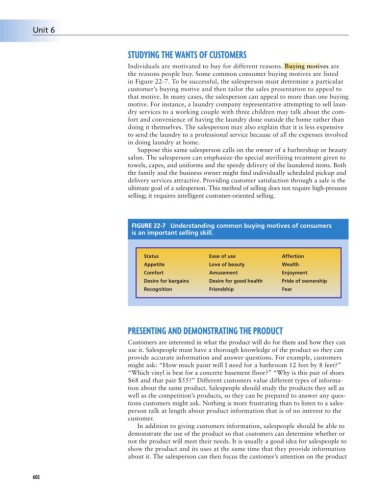
                                                the reasons people buy. Some common consumer buying motives are listed
                                                in Figure 22-7. To be successful, the salesperson must determine a particular
                                                customer’s buying motive and then tailor the sales presentation to appeal to
                                                that motive. In many cases, the salesperson can appeal to more than one buying
                                                motive. For instance, a laundry company representative attempting to sell laun-
                                                dry services to a working couple with three children may talk about the com-
                                                fort and convenience of having the laundry done outside the home rather than
                                                doing it themselves. The salesperson may also explain that it is less expensive
                                                to send the laundry to a professional service because of all the expenses involved
                                                in doing laundry at home.
                                                   Suppose this same salesperson calls on the owner of a barbershop or beauty
                                                salon. The salesperson can emphasize the special sterilizing treatment given to
                                                towels, capes, and uniforms and the speedy delivery of the laundered items. Both
                                                the family and the business owner might find individually scheduled pickup and
                                                delivery services attractive. Providing customer satisfaction through a sale is the
                                                ultimate goal of a salesperson. This method of selling does not require high-pressure
                                                selling; it requires intelligent customer-oriented selling.


                                                 FIGURE 22-7 Understanding common buying motives of consumers
                                                 is an important selling skill.


                                                     Status              Ease of use            Affection
                                                     Appetite            Love of beauty         Wealth
                                                     Comfort             Amusement              Enjoyment
                                                     Desire for bargains  Desire for good health  Pride of ownership
                                                     Recognition         Friendship             Fear


                                                PRESENTING AND DEMONSTRATING THE PRODUCT

                                                Customers are interested in what the product will do for them and how they can
                                                use it. Salespeople must have a thorough knowledge of the product so they can
                                                provide accurate information and answer questions. For example, customers
                                                might ask: “How much paint will I need for a bathroom 12 feet by 8 feet?”
                                                “Which vinyl is best for a concrete basement floor?” “Why is this pair of shoes
                                                $68 and that pair $55?” Different customers value different types of informa-
                                                tion about the same product. Salespeople should study the products they sell as
                                                well as the competition’s products, so they can be prepared to answer any ques-
                                                tions customers might ask. Nothing is more frustrating than to listen to a sales-
                                                person talk at length about product information that is of no interest to the
                                                customer.
                                                   In addition to giving customers information, salespeople should be able to
                                                demonstrate the use of the product so that customers can determine whether or
                                                not the product will meet their needs. It is usually a good idea for salespeople to
                                                show the product and its uses at the same time that they provide information
                                                about it. The salesperson can then focus the customer’s attention on the product


                  602

