


Page 640 - Business Principles and Management
P. 640
Chapter 23 • Managing Human Resources


                            • Employees may choose to transfer to jobs that better meet their current
                              interests and needs.
                            • Employees may be transferred to overcome difficulties resulting from
                              poor performance or conflicts with other people on the job.
                           Some situations require employees to leave the company. Some employee
                        separations are permanent, and others are temporary. They may result from a
                        downturn in the economy or in the company’s fortunes. Employees may also be
                        released because they have violated company policies or have been unsuccessful
                        at improving unsatisfactory job performance.
                           A discharge is the release of an employee from the company due to inappro-
                        priate work behavior. In ordinary language, this means that the employee is fired.
                        Careful procedures must be followed to make sure the reasons for the discharge
                        are a clear violation of company rules and policies and have been communicated
                        to the employee. A layoff is a temporary or permanent reduction in the number
                        of employees because of a change in business conditions. After a layoff, employ-
                        ees may be called back to work when jobs become available again. When a com-
                        pany plans a large number of layoffs, the human resources department should
                        help employees plan for them. HR may help locate other jobs, offer personal and
                        career counseling, or provide retraining for other jobs within the company.


                        EMPLOYEE TURNOVER
                        Employee turnover is the rate at which people enter and leave employment in a
                        business during a year. The rate of turnover is important to a business because the
                        loss of experienced employees means that new employees have to be hired and
                        trained. New employees will not be as productive as experienced ones for some
                        time. Between the time an experienced employee leaves and a new employee is
                        hired, the remaining employees are often called on to get the work done. Most
                        companies watch their employee turnover rate carefully and make every effort
                        to keep it low.
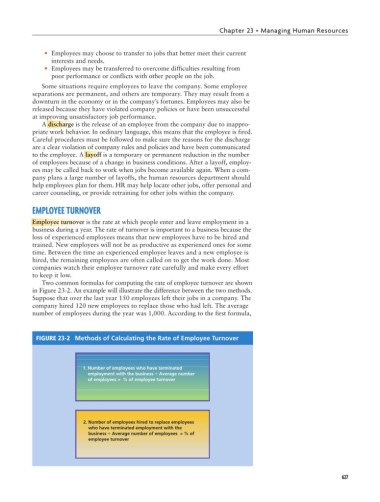
                           Two common formulas for computing the rate of employee turnover are shown
                        in Figure 23-2. An example will illustrate the difference between the two methods.
                        Suppose that over the last year 150 employees left their jobs in a company. The
                        company hired 120 new employees to replace those who had left. The average
                        number of employees during the year was 1,000. According to the first formula,


                         FIGURE 23-2 Methods of Calculating the Rate of Employee Turnover


                                        1. Number of employees who have terminated
                                            employment with the business ÷ Average number
                                            of employees =  % of employee turnover


                                        2. Number of employees hired to replace employees
                                            who have terminated employment with the
                                            business ÷ Average number of employees  = % of
                                            employee turnover


                                                                                                                         627

