


Page 413 - Basic College Mathematics with Early Integers
P. 413
390                            C HAPTE R 5 I RATIO, PROPORTION, AND MEASUREMENT


                                           Borrow 1 yd=3 ft
                                           5 yd+ 1 yd  3 ft
                                                 6 yd 1 ft   =        5 yd 4 ft
                                               – 2 yd 2 ft   =      – 2 yd 2 ft
                                                                      3 yd 2 ft
                                        The remaining rope is 3 yd 2 ft long.

                                          Work Practice 8

                                       Objective      Defining and Converting Metric System
                                                      Units of Length

                                       The basic unit of length in the metric system is the meter. A meter is slightly longer
                                       than a yard. It is approximately 39.37 inches long. Recall that a yard is 36 inches long.

                                                             1 yard  36 inches


                                                              1 meter  39.37 inches
                                           All units of length in the metric system are based on the meter.The following is
                                       a summary of the prefixes used in the metric system. Also shown are equivalencies
                                       between units of length. Like the decimal system, the metric system uses powers of
                                       10 to define units.

                                                                  Metric Units of Length
                                                              1 kilometer 1km2 = 1000 meters (m)
                                                            1 hectometer 1hm2 = 100 m
                                                            1 dekameter (dam) = 10 m
                                                                 1 meter 1m2  1 m
                                                              1 decimeter 1dm2 = 1>10 m or 0.1 m
                                                             1 centimeter 1cm2 = 1>100 m or 0.01 m
                                                             1 millimeter 1mm2 = 1>1000 m or 0.001 m


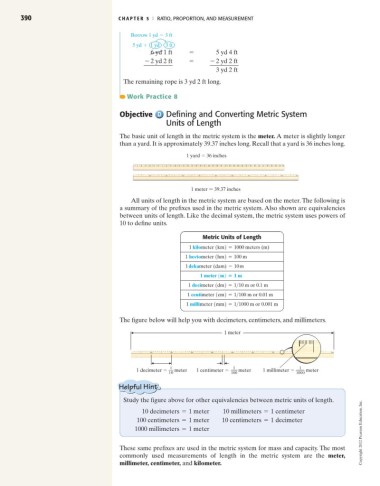
                                       The figure below will help you with decimeters, centimeters, and millimeters.
                                                                         1 meter


                                                                           1                     1
                                             1 decimeter  Å meter  1 centimeter        meter  1 millimeter          meter
                                                                           100                  1000


                                        Study the figure above for other equivalencies between metric units of length.
                                               10 decimeters = 1 meter   10 millimeters = 1 centimeter
                                              100 centimeters = 1 meter  10 centimeters = 1 decimeter
                                             1000 millimeters = 1 meter                                             Copyright 2012 Pearson Education, Inc.


                                       These same prefixes are used in the metric system for mass and capacity. The most
                                       commonly used measurements of length in the metric system are the  meter,
                                       millimeter, centimeter, and kilometer.

