


Page 600 - Basic College Mathematics with Early Integers
P. 600
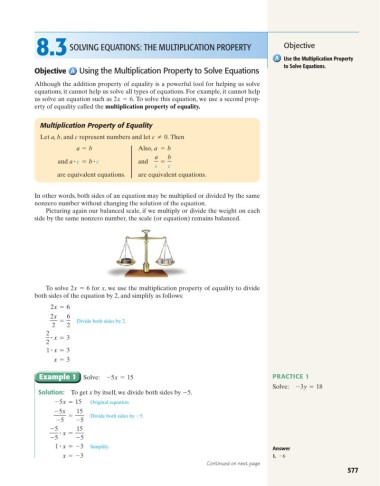
8.3       SOLVING EQUATIONS: THE MULTIPLICATION PROPERTY                       Objective


                                                                                            Use the Multiplication Property
                                                                                            to Solve Equations.
            Objective     Using the Multiplication Property to Solve Equations
            Although the addition property of equality is a powerful tool for helping us solve
            equations, it cannot help us solve all types of equations. For example, it cannot help
            us solve an equation such as 2x = 6.  To solve this equation, we use a second prop-
            erty of equality called the multiplication property of equality.

              Multiplication Property of Equality

              Let a, b, and c represent numbers and let c Z 0.  Then
                         a = b               Also, a = b
                                                  a    b
                         #
                               #
                   and a c = b c            and     =
                                                  c    c
                   are equivalent equations.  are equivalent equations.

            In other words, both sides of an equation may be multiplied or divided by the same
            nonzero number without changing the solution of the equation.
                Picturing again our balanced scale, if we multiply or divide the weight on each
            side by the same nonzero number, the scale (or equation) remains balanced.


                To solve 2x = 6  for x, we use the multiplication property of equality to divide
            both sides of the equation by 2, and simplify as follows:
                  2x = 6
                 2x   6
                    =    Divide both sides by 2.
                  2   2
                2
                   #  x = 3
                2
                 #
                 1 x = 3
                    x = 3


             Example 1      Solve:  -5x = 15                                            PRACTICE 1
                                                                                        Solve:  -3y = 18
             Solution:  To get x by itself, we divide both sides by -5.
                   -5x = 15   Original equation
                  -5x    15
                       =      Divide both sides by -5 .
                   -5    -5
                 -5      15
                    #  x =
                 -5      -5
                    #
                    1 x =-3   Simplify.                                                 Answer
                       x =-3                                                            1. -6
                                                                   Continued on next page
                                                                                                                577

