


Page 612 - Basic College Mathematics with Early Integers
P. 612
S E C T I O N  8.4 I SOLVING EQUATIONS USING ADDITION AND MULTIPLICATION PROPERTIES             589

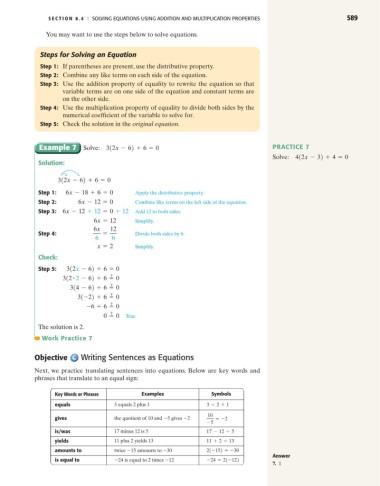
                You may want to use the steps below to solve equations.


              Steps for Solving an Equation

              Step 1: If parentheses are present, use the distributive property.
              Step 2: Combine any like terms on each side of the equation.
              Step 3: Use the addition property of equality to rewrite the equation so that
                     variable terms are on one side of the equation and constant terms are
                     on the other side.
              Step 4: Use the multiplication property of equality to divide both sides by the
                     numerical coefficient of the variable to solve for.
              Step 5: Check the solution in the original equation.


             Example 7      Solve:  312x - 62 + 6 = 0                                   PRACTICE 7
                                                                                        Solve:  412x - 32 + 4 = 0
             Solution:

                   3(2x-6)+6=0

             Step 1:   6x - 18 + 6 = 0      Apply the distributive property.
             Step 2:       6x - 12 = 0      Combine like terms on the left side of the equation.
             Step 3:   6x - 12 + 12 = 0 + 12  Add 12 to both sides.
                                6x = 12     Simplify.
                               6x   12
             Step 4:              =         Divide both sides by 6.
                               6     6
                                  x = 2     Simplify.
             Check:
             Step 5:   312x - 62 + 6 = 0
                        #
                      312 2 - 62 + 6    0
                        314 - 62 + 6    0
                           31-22 + 6    0
                              -6 + 6    0
                                   0    0  True
             The solution is 2.
              Work Practice 7


            Objective      Writing Sentences as Equations

            Next, we practice translating sentences into equations. Below are key words and
            phrases that translate to an equal sign:

                  Key Words or Phrases        Examples              Symbols
                  equals             3 equals 2 plus 1             3 = 2 + 1

                                                                   10
                  gives              the quotient of 10 and -5  gives -2  =-2
                                                                   -5
                  is/was             17 minus 12 is 5              17 - 12 = 5
                  yields             11 plus 2 yields 13           11 + 2 = 13
                  amounts to         twice -15  amounts to -30     21-152 =-30
                                                                                        Answer
                  is equal to         -24  is equal to 2 times -12  -24 = 21-122
                                                                                        7. 1

