


Page 742 - Basic College Mathematics with Early Integers
P. 742
718                            A PPEND I X  B I EXPONENTS AND POLYNOMIALS


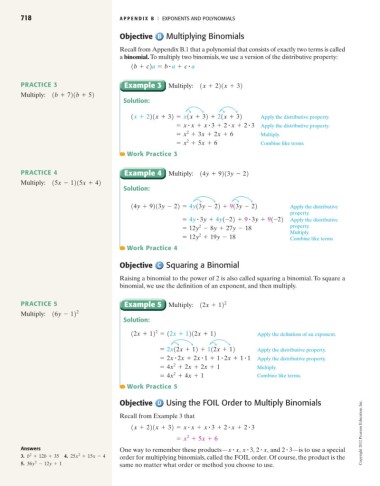
                                       Objective      Multiplying Binomials

                                       Recall from Appendix B.1 that a polynomial that consists of exactly two terms is called
                                       a binomial. To multiply two binomials, we use a version of the distributive property:
                                                       #
                                                             #
                                           1b + c2a = b a + c a
        PRACTICE 3                       Example 3     Multiply:  1x + 221x + 32

        Multiply:  1b + 721b + 52
                                        Solution:

                                           (x+2)(x+3)=x(x+3)+2(x+3)                 Apply the distributive property.
                                                                                #
                                                                    #
                                                             #
                                                                          #
                                                         =x   x+x   3+2   x+2   3   Apply the distributive property.
                                                             2
                                                         =x +3x+2x+6                Multiply.
                                                             2
                                                         =x +5x+6                   Combine like terms.
                                          Work Practice 3
        PRACTICE 4                       Example 4     Multiply:  14y + 9213y - 22
        Multiply:  15x - 1215x + 42
                                        Solution:


                                           (4y+9)(3y-2)=4y(3y-2)+9(3y-2)                      Apply the distributive
                                                                #                #            property.
                                                          =4y   3y+4y(–2)+9   3y+9(–2)        Apply the distributive
                                                                 2
                                                          =12y -8y+27y-18                     property.
                                                                 2
                                                          =12y +19y-18                        Multiply.
                                                                                              Combine like terms
                                          Work Practice 4
                                       Objective      Squaring a Binomial

                                       Raising a binomial to the power of 2 is also called squaring a binomial. To square a
                                       binomial, we use the definition of an exponent, and then multiply.

        PRACTICE 5                       Example 5     Multiply:  12x + 12 2
        Multiply:  16y - 12 2
                                        Solution:

                                                   2
                                           (2x+1) =(2x+1)(2x+1)                    Apply the definition of an exponent.
                                                   =2x(2x+1)+1(2x+1)               Apply the distributive property.
                                                                 #
                                                                        #
                                                                               #
                                                         #
                                                   =2x   2x+2x   1+1   2x+1   1    Apply the distributive property.
                                                        2
                                                   =4x +2x+2x+1                    Multiply.
                                                        2
                                                   =4x +4x+1                       Combine like terms.
                                          Work Practice 5
                                       Objective      Using the FOIL Order to Multiply Binomials

                                       Recall from Example 3 that
                                                                          #
                                                                                #
                                                                    #
                                                             #
                                             1x + 221x + 32 = x x + x 3 + 2 x + 2 3                                 Copyright 2012 Pearson Education, Inc.
                                                             2
                                                           = x + 5x + 6
                                                                                #
        Answers                        One way to remember these products—x x, x 3, 2 x,  and 2 3 —is to use a special
                                                                                            #
                                                                                    #
                                                                           #
          2
                          2
        3. b + 12b + 35  4. 25x + 15x - 4  order for multiplying binomials, called the FOIL order. Of course, the product is the
            2
        5. 36y - 12y + 1               same no matter what order or method you choose to use.

