


Page 844 - Basic Electrical Engineering
P. 844
produced are comparatively weaker than the field produced in a PMMC
               instrument. For this reason the reading of a wattmeter may get somewhat
               affected due to any strong magnetic field. Temperature rise due to current

               flow through the coils is another source of error in the instrument reading.
                  If the pressure coil inductance is considerable, it will create some error in

               the instrument reading. There are other reasons for causing error in the
               reading of a wattmeter unless some remedial measures are taken in the design

               of the instrument. The various other sources of error and their remedies are
               discussed in brief as follows.


               (a) Error Due to Inductance of the Pressure Coil


               The pressure coil of the wattmeter has some inductance as it is made up of a
               number of turns and the current flowing through it is alternating in nature.

               While deriving the torque equation for the wattmeter, however, we neglected
               this inductance and had considered only the resistance of the pressure coil

               circuit. By assuming the pressure coil circuit as resistive we had considered
               the pressure coil circuit current being in phase with the voltage.
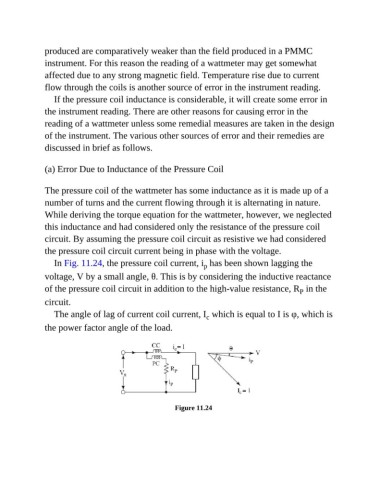
                  In Fig. 11.24, the pressure coil current, i  has been shown lagging the
                                                                   p
               voltage, V by a small angle, θ. This is by considering the inductive reactance

               of the pressure coil circuit in addition to the high-value resistance, R  in the
                                                                                                  P
               circuit.

                  The angle of lag of current coil current, I  which is equal to I is φ, which is
                                                                   c
               the power factor angle of the load.


                                                         Figure 11.24

