


Page 15 - Zone Magazine Issue 007
P. 15
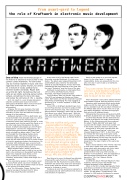
from avant-gard to legend
the role of Kraftwerk in electronic music development
One of the most mentioned groups in the history of electronic music surely is the german combo Kraftwerk. For some they only do minimal repetetive music with text fragments from nursery rhymes, for others it's a mixture of social, political lyrics between Goethe and Dada. Maybe both are a little bit right. Sometimes the text parts are as simple as boing, peng, bumm, tschack, sometimes it's more into deep and recites the old lyrics of J.W. v. Goethe.
So it can result in a very strange discussion between scientists and music lovers when talking about Kraftwerk where none of the both sides really understand what the other is talking about.
Anyway, Ffor me as a musician, the most important about Kraftwerk is that they were innovative in their time and had the courage to express it to the audience.
Kraftwerk started in 1970 by Ralf Hutter and Florian Schneider they brought music to a whole new level. Until then the mainstream only consisted of either easy listening sounds or really experimental such like the early Pink Floyd or on the other side many little bands in the Rock Section. Kraftwerk developed out of the Project "Organisation“ (shorted for:“Organisation zur Verwirklichung gemeinsamer Musikkonzepte „) which only had one album called "Tone Float“ and founded the Kling Klang studios where Kraftwerk began. The cast of characters in Kraftwerk slightly changed through time. Ralf Hutter left the band end of 1970 for some month to finish his academic studies of architecture. On December 26th Kraftwerk gave a concert with Florian Schneider-Esleben, Eberhard Kranemann (Bass, Cello) and Charly Weiss (Drums).
When Michael Rother (Guitar) entered the band (I had the real honor to talk to him on the electri_city conference in Dusseldorf) and Klaus Dinger who replaced Charly Weiss on the drums, Kraftwerk consisted of Schneider, Hohmann, Kranemann, Rother and Dinger for a few months.
They recorded a session in the studio owned by Conny Plank which was never released but was by far the best that Kraftwerk had ever done in the opinion of Michael Rother.
As a Trio (Schneider, Dinger, Rother) they played a live gig at the Beat Club TV Show where they played Rucksto Gondoliere.
At the end of 1971 Ralf Hutter and Florian Schneider recorded Kraftwerk 2 in their own studio. The album was released November 1971 and Kraftwerk was voted for the best band awards by Sounds Magazine. Florian Schneider reached the 2nd place Musician of the year and the track “Ruckzuck” was the Song of the year.
Kraftwerk toured nearly un-interrupted from 1971 to 1972 with Plato Rivera, Florian Schneider, Ralf Hutter and Emil Schult.
The 3rd album “Ralf und Florian” was made in July 1973 and released in October on Philips Label. Ralf Hutter and Florian Schneider founded Kling Klang and Wolfgang Flur was engaged as Drummer for a TV show “aspekte” in ZDF (2nd German TV).
From 1973 on Kraftwerk decided to go more into the Pop direction and tried to produce their stuff in fully electronic way. The result of this was the album "Autobahn“ which was the worlds first album in so called "Electro-pop“. With this they were setting the basics to many of today's electronic music-styles. But, as Michael Rothers said:
“We are not the only ones responsible for today's
Techno, House and Hiphop. This was more a creation of the journalists as well as the legend-status of Kraftwerk. We only wanted to make some innovative music and were sure ahead anyone else in creating innovations. But we have never considered being a legend. Legends are people who already ended their ways. We are still here".
One thing is for sure: Kraftwerk has definitely influenced the early Techno or House Artists and maybe the Hip Hop Scene too and without Kraftwerk the whole thing may have developed into a totally different direction. But the time was up to a change in music.
Creatives all over the world were looking for a new playground and with Kraftwerk they found a new direction of inspiration.
Being a role model is on one side a great honor, on the other hand it´s a great responsibility. Some are pressed into this role who even don´t want it and so is Kraftwerk. Michael Rother:
” You can never know how it is to be a role model, until you are one. But at this time it´s too late to learn to be one”
After “Autobahn” many other albums followed and Kraftwerk stayed with the electronic music. Speeches with acoustical effects and melodic
leads are still the main parts of the Kraftwerk works. Autobahn was the last album released on the Phillips label and it was the first one to get gold status worldwide, and also the single got high into the US billboard charts.
Motivated by the success and pushed by EMI, Kraftwerk founded their own label "Kling- Klang“.
In 1975 Klaus Roeder left the band and was replaces by drummer and studio musician Karl Bartos. In the following month they produced the album "Radio-Aktivität“ and again had success with the single, which was number one in the french charts for weeks in early 1976.
At the end of 1976 they recorded their 6th album "Trans Europa Express“ which was released beginning of 1977. A short time after the release the title song of the same name, grew popular in the ghettos of New York were it had great influence on the early Hip Hop DJ's like Afrika Bambataa. It developed to a kind of blueprint for the basic rhythm of the early Hip Hop tracks.
After a 5 year absence from TV they returned to ZDF with a totally new outfit, dressed like living robots with grey pants, red shirts, black ties and sequencing red LEDs and they presented their new song "(Wir sind die...) Roboter“ to the audience. This new appearance was sometimes interpreted as “Hitler on the dancefloor” (Dr. Des. Melanie Schiller Groningen/NL).
In 1978 the album "Mensch Maschine“ (Man mashine) with the single "Das Modell“ was released and again it sets standards.
When in the 80´s, bands like Depeche Mode and Ultravox oriented on the sound of Mensch Maschine, Kraftwerk was already one step ahead. The 8th album "Computerwelt“ was released in 1981 and set the basics for genres
ESSENTIALDANCEMUSIC	15


