


Page 33 - Caribbean Reef Life Demo
P. 33
76
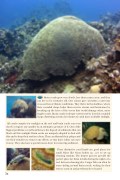
Brain corals grow very slowly, less than 5 mm a year, and they can live to be centuries old. One colony gave scientists a 500-year cross section of climate conditions. They thrive in the shallows, where their rounded shape helps them survive storms and hurricanes by breaking up the force of the waves that would damage other, more fragile corals. Brain corals in deeper waters tend to lose this rounded shape,  attening out into low domes to catch more available sunlight.
All corals compete for sunlight on the reef and brain corals can even slowly overgrow one another in an attempt to get more of it. One of the biggest problems a coral head faces is the deposit of sediments that can block out this sunlight. Brain corals are uni uely adapted to deal with this and to keep their surfaces clean. They can distend their polyps and use their tentacles to remove any debris, or tiny hairs  cilia  can wave it away. They also have a special mucus layer for removing sediment.
These distinctive coral heads are good places for small  shes like Neon  obies  p. 247  to set up cleaning stations. The deeper grooves provide the perfect place for them to hide during the night or to rest between cleaning jobs. Larger  sh can often be seen circling around brain corals, waiting for their turn to come in and get themselves cleaned.


