


Page 48 - Caribbean Reef Life Demo
P. 48
CORAL DISEASES : CORALS
BLACK BAND DISEASE
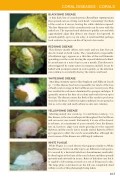
A thin dark line of cyanobacteria  Roseofilum reptotaenium  that spreads across a living coral head,  consuming  the  esh of the coral as it moves, leaving the white skeleton exposed. The  ne  laments of this cyanobacteria can be seen with the naked eye. The exposed coral skeleton is  uickly covered with opportunistic algae that destroy any chance for regrowth. It spreads  uickly, up to 2.5 cm a day. A coral head that perhaps took centuries to grow can die off in just a few weeks.
RED BAND DISEASE
This disease mostly affects soft corals and sea fans but can also be found on hard corals. The cyanobacteria responsible (Oscillatoria spp.  appears as a thin line of  ne red  laments spreading over the coral, leaving the exposed skeleton behind. It can advance at a rate of up to 5 cm a month. This disease is often triggered by warm waters in summer and fall. It can be halted with an improvement in water  uality, or the infection can continue to eventually destroy the entire coral head.
WHITE BAND DISEASE
Attacking Acropora species like Staghorn and Elkhorn Corals  p. 73  this disease has been responsible for much of the loss of hard coral coverage in the Caribbean over recent years. This has resulted in reefs more dominated by sponges and algae. It generally starts at the base of a colony and works its way up to the tips. The disease causes the  esh of the corals to peel away from the skeleton.  nder the right conditions it can spread as fast as 1 cm a day and easily advances onto new colonies.
YELLOW BAND DISEASE
Affecting mainly star corals  p. 82  and brain corals  p. 76 , this disease is the most widespread throughout the Caribbean and can occur year-round. Fortunately it is one of the slowest to advance, at a maximum of 4 cm a month. Once the disease sets in, however, algae soon starts growing over the exposed skeleton and the coral’s fate is usually sealed. Bacteria  Vibrio sp.) appears to affect the coral’s zooaxanthellae, although the exact causes of this disease are still largely unknown.
WHITE PLAGUE
White  lague is a coral disease that appears similar to White Band Disease but it can affect up to 40 different coral species. It is caused by a bacterial infection  Aurantimonas coralicida . It often begins at the base of the coral colony and then spreads upwards and outwards in an arc. Rates of infection vary but it is capable of devouring as much as 2 cm of living coral a day. The large plate coral shown on the left was completely dead within a week of this photograph being taken.
103


