


Page 5 - Caribbean Reef Life Demo
P. 5
8
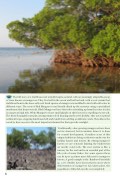
The full story of a Caribbean reef actually begins on land, with an amazingly adaptable group of trees known as mangroves. They live half in the ocean and half on land, with a root system that stabilizes them in the loose salty soil. Each species of mangrove is modi ed to deal with salt water in different ways. The roots of Red Mangroves can literally drink up the seawater using a specialized membrane that keeps out salt. Black Mangroves have tiny tubes extending up from the water to take in oxygen at high tide. White Mangroves have small glands on their leaves for expelling excess salt. The densely tangled roots play an important role in keeping nearby reefs healthy; they act as natural sediment traps, stopping land-based silt and runoff from settling on delicate corals. This allows the corals to have access to the most important element for their growth: sunlight.
Traditionally, slow-growing mangroves have been cut for charcoal, but in modern times it is done for coastal development. Countless acres of this uni ue habitat are being cut down to make way for holiday homes and resorts. By cutting mangrove forests we are seriously limiting the biodiversity on nearby coral reefs. The root system is like a nursery for the reef and is an essential part of the life cycle of many  shes. For some species there can be up to 25 times more  sh next to mangrove forests. A good example is the Rainbow  arrot sh  p. 328 . Studies have shown that in areas where deforestation of mangroves has taken place, the population of this  sh can die out completely.


