


Page 75 - Caribbean Reef Life Demo
P. 75
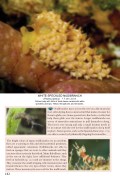
WHITE-SPECKLED NUDIBRANCH (Pauleo jubatus) < 7 cm / 2.5 in
Yellow body with tufts of thick dense cerata with white speckles and tips. Yellow rhinophores and tentacles.
Nudibranchs move across the reef on a  at muscular foot, often laying down a mucus trail that makes it easier for them to glide over. Some species have  ne hairs, or cilia, that help them glide over the mucus. Larger nudibranchs use waves of muscular contractions to pull themselves along. The foot is very strong and only a small fraction needs to be in contact with the reef for the nudibranch to keep itself in place. Some species, such as the Spanish Dancer  p. 175 , are able to swim by rhythmically  apping their mantles.
The bright colors of many nudibranchs are no accident, they are a warning to  sh and other potential predators, called aposematic coloration. Nudibranchs are able to feed on sponges that are toxic to other animals and they can store these toxins in their  esh. Many  abellinas, such as the one on the right, have additional defenses. They feed on hydroids  p. 132  and are immune to the stings. They consume the small stinging cells  nematocysts  and transfer them to the very tips of their cerata, where they mature. These nematocysts now work for the nudibranch.
182


