


Page 40 - Phil opening night program digital final
P. 40
Meet


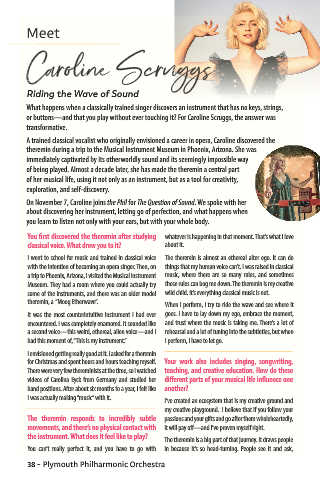
        Caroline Scruggs


        Riding the Wave of Sound
        What happens when a classically trained singer discovers an instrument that has no keys, strings,
        or buttons—and that you play without ever touching it? For Caroline Scruggs, the answer was
        transformative.
        A trained classical vocalist who originally envisioned a career in opera, Caroline discovered the
        theremin during a trip to the Musical Instrument Museum in Phoenix, Arizona. She was
        immediately captivated by its otherworldly sound and its seemingly impossible way
        of being played. Almost a decade later, she has made the theremin a central part
        of her musical life, using it not only as an instrument, but as a tool for creativity,
        exploration, and self-discovery.
        On November 7, Caroline joins the Phil for The Question of Sound. We spoke with her
        about discovering her instrument, letting go of perfection, and what happens when
        you learn to listen not only with your ears, but with your whole body.

        You first discovered the theremin after studying   whatever is happening in that moment. That’s what I love
        classical voice. What drew you to it?  about it.
        I went to school for music and trained in classical voice   The theremin is almost an ethereal alter ego. It can do
        with the intention of becoming an opera singer. Then, on   things that my human voice can’t. I was raised in classical
        a trip to Phoenix, Arizona, I visited the Musical Instrument   music, where there are so many rules, and sometimes
        Museum. They had a room where you could actually try   those rules can bog me down. The theremin is my creative
        some of the instruments, and there was an older model   wild child. It’s everything classical music is not.
        theremin, a  “Moog Etherwave”.       When I perform, I try to ride the wave and see where it
        It was the most counterintuitive instrument I had ever   goes. I have to lay down my ego, embrace the moment,
        encountered. I was completely enamored. It sounded like   and trust where the music is taking me. There’s a lot of
        a second voice—this weird, ethereal, alien voice—and I   rehearsal and a lot of tuning into the subtleties, but when
        had this moment of, “This is my instrument.”  I perform, I have to let go.

        I envisioned getting really good at it. I asked for a theremin
        for Christmas and spent hours and hours teaching myself.  Your work also includes singing, songwriting,
        There were very few thereminists at the time, so I watched  teaching, and creative education. How do these
        videos of Carolina Eyck from Germany and studied her  different parts of your musical life influence one
        hand positions. After about six months to a year, I felt like  another?
        I was actually making “music” with it.  I’ve created an ecosystem that is my creative ground and
                                             my creative playground.  I believe that if you follow your
        The theremin responds to incredibly subtle   passions and your gifts and go after them wholeheartedly,
        movements, and there’s no physical contact with   it will pay off—and I’ve proven myself right.
        the instrument. What does it feel like to play?  The theremin is a big part of that journey. It draws people
        You can’t really perfect it, and you have to go with   in because it’s so head-turning. People see it and ask,

        38 ~ Plymouth Philharmonic Orchestra

