


Page 32 - 2000 ICELAND
P. 32
for production are mined in Australia.  Aluminum production is extremely
            energy intensive.  So it was actually more cost-effective to build a plant and

            ship the raw materials to Iceland for production than to manufacture the
            product at home.


            Next,  Oskar  ran  us  up  the  neighboring  crater  where,  in  the  l970s,  many

            eruptions had occurred.  The ash covered much of this area (so we were
            looking at even newer land) and the blast blew out some pretty impressive

            chimneys.    From  the  top  of  the  crater,  we  could  look  out  and  see  other

            active  cones  and  shields.    Then  we  came  down  off  the  crater  sides  and
            struck out across  the tussocks, hopping from one to  another like  kids  for

            quite a while.


            At  last,  we  reached  the  lava  fields  that  were  to  be  the  site  for  the
            afternoon’s  serious  hike.    Talk  about  another  bizarre  and  otherworldly

            place—the lava field with its miles of ropy,  black, sharp, but easily broken
            material  is  it!    What’s  even  stranger  is  the  fact  that  the  lava  flow  just

            abruptly  stops  in  the  meadow  where  the  tussocks  grow.    Though  it  does

            break easily at the edges and form very pointed shards, it is easier to walk
            on than the big boulders we’ve been thinking were typical of all Icelandic

            hikes.  Some of the flow is black and shiny like obsidian but most of it has a
            more matte-like finish.  We walked around in this odd place for about three

            hours, even entering a still smoking crater with strong sulfide odor and hot
            rocks everywhere with yellow “dust” on them.  Our weather has been so

            beautiful all day that no one, not even Oskar, can believe our good fortune

            so far.


                                                     SULFUR MINES


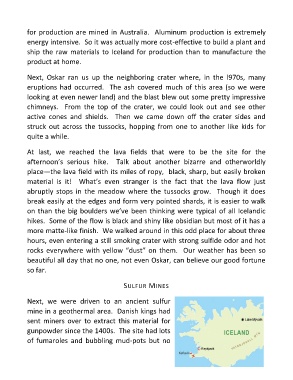
            Next,  we  were  driven  to  an  ancient  sulfur
            mine in a geothermal area.  Danish kings had

            sent miners over to extract this material for
            gunpowder since the 1400s.  The site had lots

            of  fumaroles  and  bubbling  mud-pots  but  no

